Saturday, February 03, 2024

Music and the Brain…..


Every Brain Needs Music: The Neuroscience of Making and Listening to Music. Larry S. Sherman and Dennis Plies. 2023. Columbia University Press. [ISBN 978- 0-231-20910-6. 270 pages, including index. US 32.00 (hardcover).]

Every Brain Needs Music: The Neuroscience of Making and Listening to Music is the compilation of a musical neuroscience collaboration—a synopsis of what science knows and does not yet know about how making, practicing, performing, listening, and learning music affects the brain. And beyond that, how those effects spill over into the human experience.

The book’s layout attracts the musical reader with its orchestra labels. The introduction is a “Prelude” followed by an “Overture,” a short summary of the book. Each subsequent chapter is labeled with a numerical “movement.” Music lovers will delight at the final chapter, “Coda,” knowing that the coda of a song is a short ending following one or more repeated sections.

The first “movement” begins with a detailed description of basic neuroscience. This includes the most common method of studying the active mind—a procedure called functional magnetic resonance (fMRI). It is very similar to a regular MRI but specific for the brain; it “detects the changes in the flow of blood through tiny vessels in different regions of the brain and changes in blood oxygenation, which represent changes in neuronal activity” (p. 11).

Many of the preliminary results discussed are based on fMRI studies—flawed as it is as a measure of brain activity. One significant discovery with this technique is that music alone (not other sounds) triggers specific areas of the brain. This could redefine what music is from a neuroscience perspective. Also considered was a qualitative survey taken of professional musicians of all types with the results being compiled into general trends within bar graphs included in Appendix A.

The other “movements” (chapters of this book) on practicing, performing, and listening are most relevant to many readers while the “movements” on improvising and composing pertain to a smaller percentage of their audience. All chapters discuss specific studies related to a comparison of music type and how fMRI results (or similar PET scanning) differ and how those results might be interpreted.

All readers who have ever practiced and performed music at any level can relate with the statement, “Mastering a piece can be an ongoing process of unfolding its meaning, in terms of both personal expression and the composer’s intention. It’s a search. It’s never boring, but always challenging in positive ways, for music holds poetic space” (p. 70).

Overall, this collaborative book presents a thorough synopsis of current musical neuroscience research. Unfortunately, much of it is still in the infancy stage as current technology only allows us to surmise connections between brain parts. The specific mechanisms and interchanges beyond the basic neuron level are not yet understood on a chemical level.

In the “Coda,” Larry Sherman states, “I’m struck by the amount of computational power it takes to perceive and respond to music and the fact that we still have much to learn about the underlying circuitry involved in how sound is processed in the auditory cortex before traveling to other areas of the brain” (p. 198). This coda is perhaps the prelude to yet another set of movements to be written when this is discovered.

Julie Kinyoun

Julie Kinyoun is an on-call chemistry instructor at various community colleges in Southern California. An avid reader, she enjoys reviewing books that help her become a better educator.

Sunday, August 06, 2023

Subatomic Writing: 6 Fundamental Lessons to Make Language Matter


Jamie Zvirzdin. 2023. Johns Hopkins University Press. [260 pages, including index. ISBN 978-1-4214-4612-7. US$29.95 (softcover).]

“The demon wasn’t as ugly as I’d feared, although the cheerful IKEA lighting and the sun-yellow rug in our library can make anything seem cozier, even a blue-skinned night fiend (p. 7). A very dubious quotation from what is overall, a textbook about grammar, style, syntax, and punctuation—a summary and application of rules like those in The Chicago Manual of Style or Strunk and White.

In Subatomic Writing: 6 Fundamental Lessons to Make Language Matter, Jamie Zvirzdin outlines her knowledge of advanced writing in detail and provides students with exercises at the end of each chapter. By day, Zvirzdin is a science writer and educator at Johns Hopkins University and, by night, a program analyst for the University of Utah.

Her unique approach incorporates her knowledge of the mechanics of grammar and science with her love of narrative, action, and mystery into a one-of-a-kind textbook. Zvirzdin’s imagined demon is modeled after the famous hot/cold sorting demon of the brilliant physicist James Clerk Maxwell. The author uses her fabricated “demon” to suggest the metaphor of the book that “particles of language are like particles of matter” (p. 4). And when her house cat is “Schrodingered” (disappears) upon the threat of NOT creating a manuscript, Zvirzdin is forced to comply. To get her cat back by Halloween night, she composes six lessons. In each lesson, she takes a physics concept and likens it to some aspect of writing. Some of her metaphors work better than others, but for the reader it is the process of thinking about the validity of each that makes the book achieve its goal, to provide clarity and a source of communication between these elusive subjects that so desperately need each other for mutual success.

For example, there is a problem with her metaphor that likens writing to collisions between little balls: “Because if all the world is to be explained mechanically in terms of little balls (molecules, electrons, photons, gravitons, etc.), then the only way one ball affects another ball is if the little balls hit. If that is so, collision becomes the essence of physical interaction” (p. 16). Scientists who research molecular motion and thermodynamics will recognize this as an overgeneralization about their topic—most molecules do not behave this way and that is why equations like the ideal gas law are just that—for unreal, ideal situations.

After several chapters of rather exhaustive definitions of physics terms (like quarks and leptons), Zvirzdin concludes her textbook with a return of her demon. To conclude, the mystery of the “Schrodingered cat” resolves itself when Zvirzdin submits her manuscript to the demo, and the cat miraculously reappears. A clever application of the statistically disappearing feline of quantum mechanics.

The narrative approach to Subatomic Writing provides humor and a breath of fresh air in an otherwise arduous, backbreaker science communication textbook. Zvirzdin tackles two challenging subjects by likening them to each other hoping to bring them in closer collaboration: a demon of a task.

Julie Kinyoun

Julie Kinyoun is an on-call chemistry instructor at various community colleges in Southern California. An avid reader, she enjoys reviewing books that help her become a better educator.

Tuesday, March 07, 2023

Book Review: Partial Truth


Partial Truths: How Fractions Distort Our Thinking

James C. Zimring. 2022. Columbia University Press. [ISBN 978-0-231-20138- 4. 244 pages, including index. US$28.00 (hardcover).]

In a world of exponentially growing data in all subjects, fractions and percentages are more important for both official and casual communication. In Partial Truths: How Fractions Distort Our Thinking, James C. Zimring claims that everything from scientific research to new age beliefs are distorted by bias created from numbers. By omitting sample size, failing to create appropriate data, or even manipulating existing data, our society derives faulty conclusions. His analysis of how and why this happens examines evolutionary human psychology and how misperceptions can lead to propaganda and polarization of society.

In this twelve-chapter book divided into three sections, Zimring lays out his arguments about data misperceptions. In Part 1, he explains how anecdotal evidence can persuade people with a sample size too small for valid conclusions, called “ignoring the denominator” (p. 17). A relevant example of this occurred when then President Trump claimed the United States had more cases of Covid-19 than other countries because we were testing more people. Trump ignored the denominator by failing to communicate that our rate of infection (cases per total number of people tested) was higher than other countries. Zimring goes into more depth on possible ways the data could have been collected and analyzed to derive different conclusions.

Presentation of data is just as important as our perception of it. Zimring’s focus on human psychology and perception renders his title choice a bit misleading—the book might more accurately be called Partial Truth: How Fractions and Human Psychology Distort Our Thinking. One simple psychology concept introduced and carried is that of a heuristic. “A heuristic is a process by which human minds rapidly solve complex problems by replacing them with analogous but simpler problems” (p. 32). These mental shortcuts can play tricks on our minds and influence how we formulate conclusions. Confirmation bias is another important psychological concept that “... is not a belief. Rather, confirmation bias is a process by which we reinforce our beliefs—any beliefs—regardless of origin or accuracy” (p. 42).

Part 2 focuses on how heuristics, confirmation bias, and other tendencies influence the interpretation of data that often leads to faulty outcomes. Focus areas include identification of criminals, invasion of Iraq, interpretation of coded messages in ancient texts, new age methods, evolution/natural designer arguments and, most importantly, the physical sciences.

Part 3 discusses how we can try to influence the way people think and avoid harmful polarizations of disagreement often based on the same available data. Methodology includes “epistemic network models” (p. 178) of actors in simulated social networks enacting various scenarios. Social networks analyze the effects of human tendencies, including confirmation bias and heuristics to arrive at conclusions.

In conclusion, Zimring summarizes, “We need the availability heuristic, and confirmation bias, and all of the other forms of misperceiving the fraction described herein. They fuel our advances as well as lead to our demise” (p 201). A contradictory statement of sorts alludes to the complexity of trying to decipher something that should be logical and yet is not.

Julie Kinyoun

Julie Kinyoun is an on-call chemistry instructor at various community colleges in Southern California. An avid reader, she enjoys reviewing books that help her become a better educator.

Sunday, November 06, 2022

A Book Review about Balance


Balance: How It Works and What It Means

Paul Thagard. 2022. Columbia University Press. [ISBN 978-0-231-20558-0. 336 pages, including index. US$32.00 (hardcover).]

A laboratory balance is a simple, one- dimensional instrument dating back to ancient science. In its earliest form, the apparatus achieved balance with equal masses on both sides—adding mass to either side tipped it out of balance. Paul Thagard elaborates in his book Balance: How It Works and What It Means, that although the topic of balance dates to this ancient apparatus, it expands into immensely rich, multidimensional areas. In his book, the author first explains scientifically what balance is from a biological and medical perspective and then shifts into an evaluation of balance metaphors that help us fill in the gaps of our scientific knowledge—and whether these metaphors are strong, bogus, or even toxic to culture.

Inspired by Thagard’s own bout of vertigo, the first four chapters explain the science behind human balance and some of the common conditions that result as a breakdown of the mechanisms. He continues to use his personal experience with vertigo as an example, or the “experience of illusory motion: something seems to be moving even though it is not” (p. 42). This balance malfunction usually includes a mismatch of signals from all the neurological functions involved—the inner ear canals, vision, and hair cells send information to the brain—when vertigo occurs these signals do not match, thus creating a spinning sensation.

In the section linking balance to feelings, Thagard applies his balance mechanisms to the expanding field of mind and body, or the origins of consciousness. “My . . . theory explains why balance is usually unconscious but enters consciousness when problems arise. Unlike (other theories) my theory also explains why different imbalance experiences such as vertigo and nausea come with different feelings” (p. 105).

In chapter 5, Balance shifts to an explanation of metaphor and its role in understanding balance. Thagard states that literal mechanisms only explain basic biological and medical applications of balance, yet it is much richer than that. “But balance concepts flourish in other areas of human thought, including science (chemical equilibrium), medicine (balanced diet), psychology (stable personality), art (balanced composition), and philosophy (reflective equilibrium)” (p. 106).

In this lengthy analysis covering many subjects regarding balance, Thagard again references vertigo. Most notably in his analysis of the film Vertigo starring James Stewart and Kim Novak. His observation, “Hitchcock largely flubbed the science of vertigo, but he powerfully portrayed the balance disorder of dizziness triggered by heights. Just as effectively, he presented metaphorical vertigo provoked by uncertainty in romantic relationships and especially by astonishing events that have no explanation” (p. 232).

In conclusion, the author’s analysis of balance in philosophy challenges the assumption that being out of balance is not entirely negative—the idea of metabalance. This implies that “leading a meaningful life requires finding a balance between balance and imbalance” (p. 269). Thagard concludes by suggesting that a satisfying life requires an element of both.

Julie Kinyoun

Julie Kinyoun is an on-call chemistry instructor at various community colleges in Southern California. An avid reader, she enjoys reviewing books that help her become a better educator.

Book Review about Healthcare Leadership


Human-Centered Leadership in Healthcare: Evolution of a Revolution

Kay Kennedy, Lucy Leclerc, and Susan Campis. 2022. Morgan James Publishing. [ISBN 978-1-63195-553-2. 236 pages. US$18.95 (softcover).]

Nurses in a 21st century workforce encounter new and unique problems daily: complex technology, new medicines and treatments, and a constant pressure to meet higher standards with ever shrinking resources. Conquering these issues requires effective modern nursing leadership that meets a wider variety of needs than a traditional top-down style. Nurses Kay Kennedy, Lucy Leclerc, and Susan Campis assert that their new model of nursing leadership—the human-centered model—is up to the challenge.

“Human-Centered Leadership in Healthcare embodies the principles of complexity science. It [is] different from traditional leadership in that the leader is embedded in the system. The influencers and innovators are those at the point of care” (p. 1). These three authors provide evidence for their leadership theory with a compelling Institutional Review Board- approved clinical study that yielded qualitative results. Results included anecdotes and narratives, along with literature studies and historical perspectives. Although they provide the reader with a citation to investigate the research study further, the authors’ study summary is somewhat limited. Improvements could include details that would make their conclusions more lucid; for example, the exact length of the study is omitted as well as details about the content of the focus groups. It is mentioned that they categorized the responses into a matrix and “coded” them, but this process is not explained thoroughly. Their arguments would be more compelling if more of the results were directly linked to the conclusions of their leadership model.

From this research study, the authors formulated their theory of leadership based on the idea that self- care, self-awareness, mindfulness, and emotional intelligence are all springboards upon which a leader embeds themself within a healthcare system. “Human- Centered Leaders require intentional development of skills that support the leader’s effectiveness and the ability to create a sustainable culture of Excellence, Trust and Caring” (p. 131). The authors’ outline the attributes of excellence as embodied by the Awakener: a motivator, coach, mentor, architect, and advocate (p. 131). They then list the characteristics of trust embodied by the Connector: collaborator, supporter, edge walker, engineer, and authentic communicator (p. 98). Concluding their leadership model by listing the components of caring embodied by the Upholder: mindful, others-oriented, emotionally aware, socially and organizationally aware, and personally well and healthy (p. 115). The authors’ primary argument is that a truly effective leader in nursing must have all these skills, as well as the ability to discern when it is appropriate to emphasize one over another.

Overall, Human-Centered Leadership in Healthcare: Evolution of a Revolution is an excellent resource for nurses. However, the terms and language used assume the reader has experience in both healthcare and leadership. Including a quick-reference glossary with leadership terms and nursing acronyms would be helpful for someone new to both fields. Many skills described like reflective journaling, mindfulness, and appreciative inquiry are useful in developing leaders in other service professions aside from nursing. With this leadership model, Kennedy, Leclerc, and Campis have opened the door to their “evolution of a revolution.”

Julie Kinyoun

Julie Kinyoun is an on-call chemistry instructor at various community colleges in Southern California. An avid reader, she enjoys reviewing books that help her become a better educator.

Sunday, August 28, 2022

Making Research Matter


 Health and Care Researchers

Tara Lamont. 2021. Bristol University Press [ISBN 978-1-4473-6115-2. 198 pages, including index. US$34.95 (softcover).]

“Researchers start their work wanting to make a difference. The extra steps and actions set out in this book and elsewhere to reach and engage people in meaningful ways, paying attention to story, language and appropriate channels are part of the job of a researcher in the 21st century. Research findings should not stay in the library or on the university bookshelf. They should be translated and worked up with the right communities into new policies, decisions, conversations and practice” (p. 166). This summary statement of Making Research Matter: Steps to Impact for Health and Care Researchers by Tara Lamont embodies her argument that the relevance of current research and its resulting impact on society are critical now more than ever.

Lamont’s introduction uses her own storytelling tools of chapter 8, the example of Florence Nightingale and her report to the Indian Sanitary Commission, published in 1863. The “pull” Nightingale created for her report included concise and orderly summaries with vivid images. These briefs were circulated among people like John Stuart Mill and even Queen Victoria- people whose support she would need later in promoting the policy and reforms suggested in her report. Nightingale forged ties with decision makers who could implement reforms themselves or communicate with others for influential changes. And she did it all without Twitter, Facebook, and LinkedIn! It is proof that the skills of impact for research resonate then as they do now despite the vast difference in the technological tools available.

Making Research Matter starts each chapter using the Why, What, Who, When and How format. The Why follows the introduction to clarify the overall importance of her book. In the current information and digital climate, the sheer amount of research available has increased exponentially. It is important for people to discern valuable research from either false data or irrelevant results. Valuable research involves asking the right questions of the population involved. One example compared mechanical devices to manual compressions in treating cardiac arrest in an ambulance. A high-quality research study proved that the outcomes for each showed negligible difference, and therefore the cost of implementation was not worth it. However, when staff were interviewed, they said that the technology allowed them to sit securely in a seatbelt which made them feel safer. This detail addressed a separate issue from cost analysis and could only be determined through interviewing the right people.

Lamont’s arguments for increased communication and interaction between researchers, policy makers, and lay people describes an ideal culture of collaboration, support for necessary reform and openness to change. It is her hope that researchers in all areas of health and care examine their skills, interest, and investment in this type of exchange for the enhanced quality, relevance, and implementation of valuable research findings into all areas of healthcare and wellness.

Sunday, August 07, 2022

New Digital Natives


Supporting New Digital Natives: Children’s Mental Health and Wellbeing in a Hi-Tech Age

Michelle Jayman, Maddie Ohl, and Leah Jewett, eds. 2021. Bristol University Press. [ISBN 978-1-4473-5645-5. 210 pages, including index. US$45.95 (softcover).]


Mental wellness and digital technology are traditionally not viewed as collaborative partners, especially in youth development. The negative aspects of digital technology include cyberbullying, inappropriate visualcontent, social media competition, and the (sometimes) misconception of “too much screen time.” However, nobody can dispute that exposure to technology is unavoidable—from online homework to discussion groups on Zoom, students are required to have an email address in early elementary school. With the new reality of technology-savvy younger children, it is critical to figure out the implementation of it for maximum benefits/fewest risks and how to impose critical boundaries. To this end, Supporting New Digital Natives: Children’s Mental Health and Wellbeing in a Hi-Tech Age was compiled in ten chapters with sources at the end of each chapter, a section on the background of the contributors, a glossary, and index. The editors selected eight case studies by health care providers, teachers, and mental health professionals/researchers to approach mental wellness from a complex wholistic landscape rather than examining any one influencing factor.

“These eight case studies were selected because of their original contributions, each focusing on different aspects of CYP’s (children and young people) lives which are inextricably linked to mental wellbeing, such as friendships and relationships, play and learning experiences, and opportunities for connecting with nature and the community. More than this, each chapter is a platform for raising CYP’s voice, rightly placing them, as experts in their own lives, at the heart of mental wellbeing interventions and services” (p. xxx).

Ironically, the first case study on supporting new digital natives (as the title states) introduces a pyramid club that removes children from all technology and places them in an intentional support group—an environment where they can practice relationship building in a supportive place. For ten weeks, kids meet with other kids who either lack social skills and/or have trouble with friendships. During these ten weeks, the kids do activities targeted toward connection, building teamwork, and creating a safe space like arts and crafts, food preparation and sharing, and circle time. This approach contrasts with the next case study in which Book of Beasties is used to explore how to get children to build virtual friendships through an online card game. “Children learn best in interactive environments which invite them in as interactive collaborators and include content which is meaningful to them” (p 96).

One of the common negatives associated with digital technology is the reduction of outdoor play for children—this is the basis of Forest School and Girlguiding. These case studies look at the effects of nature on the mental wellbeing of youth and the importance of building a support community. In the girlguiding study, the implementation of digital technology has improved some of the programs and the girls are encouraged to use the technology if it helps them.

One of the final case studies introduces LifeMosaic—an app for a smartphone that tracks various data points that might help children understand their mental health better. For example, after tracking sleep and diet they might see the link between poor eating habits and poor sleep quality—and their overall mood as a result. The app allows children to design their own study and then plot graphs and charts which can be shared within their online LifeMosaic community.

All these studies describe either the use of technology to enhance mental wellbeing or the intentional removal of technology to eliminate a technology-driven issue—the intersection of which is a balance the new digital natives of our generation will be forced to eventually navigate themselves.

Julie Kinyoun

Julie Kinyoun is an on-call chemistry instructor at various community colleges in Southern California. An avid reader, she enjoys reviewing books that help her become a better educator.

Saturday, May 07, 2022

How to Lead in Data Science


How to Lead in Data Science

Jike Chong and Yue Cathy Chang. 2021. Manning Publications Co. [ISBN 978-1-61729-889-9. 514 pages, including index. US$59.99 (softcover).]

Many recent advancements in our world are data science (DS) applications in industry/academia. In healthcare, genomics/virus research relies on vast databases to make life saving vaccines for public health. Handheld devices may soon transform the way healthcare operates by transmitting real-time data. In the field of artificial intelligence, the neural net is only as effective as the “learning” it does with data input to “teach” it how to conduct its task. These applications support the relevance of How to Lead in Data Science to create, organize, and manage leadership in the field. For this reason, it is a needed resource for an expanding industry.

Jike Chong and Yue Cathy Chang state that they authored this book for data scientists. Lay readers may have difficulty with the book yet are encouraged to scan through it as it can serve as a generic management guide. This book describes concepts that are universal to other technical fields, which makes it useful across all industries besides the growing DS field. “The contribution of DS to the economy is still in its infancy as of 2021. According to LinkedIn Talent Solutions data, the discipline has found the most traction in IT, computer software, and internet industries” (p. 412). Growth in the data scientist field is occurring in financial services, banking, insurance, health care, biotech, pharmaceuticals, and fitness, and is likely to increase quickly due to delays in current product pipelines. “The scarcity of data product manager talent is a significant bottleneck for companies looking to develop data and intelligence-driven products and features” (p. 454).

The initial chapters introduce real-life data scientists at varying levels of their career development. Each scientist is analyzed according to their positive performance and areas of needed growth. The authors tie these examples to detailed graphs of the progressive levels of data science advancement. The book uses the TEE-ERA fan (Technology, Execution, Expert Knowledge, Ethics, Rigor, Attitude) in Figure 2.1 of Chapter 2, which also appears on the inside of the back cover. The authors refer to these capabilities and virtues at all levels of the data scientist’s development from a strong technical lead to a manager to a director and, finally, to arrive at the executive level of performance. (The authors also outline a second career track as the path of an individual data scientist outside of management.)

Although How to Lead in Data Science emphasizes that technical knowledge and expertise are foundational to DS, these are the bare minimum skills for survival. The authors sprinkle advice throughout the book with tips for thriving in the field with the most important being to select an industry you like and will grow to love. Only with this affinity can you develop proper relationships with others, remain positive, keep current on technical advances, and keep a relevant skill set for influencing and inspiring an industry. The bottom line is to prove that data can bring impact and success in data science through this detailed guide. Who could go wrong!

Julie Kinyoun

Julie Kinyoun is an on-call chemistry instructor at various community colleges in Southern California. An avid reader, she enjoys reviewing books that help her become a better educator.

Tuesday, March 08, 2022

Being a Mom


Recently I processed my infant-mothering days from the rear-view mirror by compiling an album for the family of a friend. It was for the family of this friend and not the friend herself because my friend died. Yes, my forty-year-old, “younger” friend died of colon cancer. Sigh. That is a different blog post. 

On the cover of the album is a beautiful photo of six soul sisters- six women who banded together and shared maternity and baby clothes, birthday and pool parties, holiday cookie exchanges and weekly play dates at people’s homes and at local parks. We are all calmly smiling for a perfectly posed picture of a perfect friendship because we had just sailed carefree through motherhood together….. NOT! I look at these six women (and two toddlers who unknowingly photobombed our picture by running to mommy) and I know we were tired, we had just disagreed about the time and location of our picnic and some of us had done a separate party with alcohol the night before. That is why this cover photo is unique- never before had someone (my parents in this case) gotten us organized for such a picture. The rest of the 50 assorted photos of these women include one or more of us as dots in the background, serving food, speaking to a child while holding a plate and balancing a baby in the other arm. Truthfully most of the pictures are just of the kids- playing at the park, eating, blowing birthday candles, and posing for mom saying “smile for a picture honey.” 
You can’t survive motherhood alone. Period. With a brand new baby I showed up at mommy events designed for the isolated, family out-of-town mother to bond with other moms only to be asked to work in childcare (What?) or to meet women who lived an hour’s drive across town or just to leave feeling rejected in some way. Wasn’t I the pretty, involved, musically talented teenager who qualified for a highly-select college with professionals at the highest level of accomplishment? What happened to popular me? Now I was the slightly pudgy (from pregnancy), perpetually tired, slightly out-of-fashion maternity clothes who was always asking for a babysitter. People started to avoid me when I would arrive. What is she asking for now? I was thinking THEY were thinking.

So to find a group of women who wanted to share these moments was inner-soul soothing. Being accepted on the raw level of something never experienced- being in a low, vulnerable place and having other women surround me and say “we are here too.” Not perfect but definitely critical. I recently told the sister of my deceased friend:  Mothering is the hardest thing you will ever do. People you thought were your friends will disappear and let you down. You will feel alone. You will feel rejected or not good enough or lonely. You will show up at the park with your baby only to feel left out by the elementary-school aged moms who all know each other from soccer league. You will sit with your baby, not knowing anybody, and nobody will introduce themself to you. They look right through you. They do not need a woman with a baby nor is a woman with a baby of any use to them. You are a nuisance. You are an extra responsibility. You are a person always looking to shift responsibility onto others. And it doesn’t matter if that is not who you are- people will make you feel that way.

The album for my friend’s family is called “Good Times.” Our smiles in these select twenty photos don’t reveal our exhaustion, our health problems, our recent fight with our spouse, our disagreements or disappointments with each other, our own insecurities with our body image, relationships and extended family. But we survived and even overcame and thrived despite these things partly because we found each other. Closer with some women at certain times than others- that too changed as time went by. The woman with whom I currently communicate most was probably the woman I knew the least at the time of the photo. Now our kids play on the same sports teams and we see each other frequently. Of the other four, one lives in an adjoining neighborhood and we occasionally bump into each other on a walk, two moved out of the country (and then one of those died), and one lives a few miles away with kids at different schools and in different activities (she has boys and I have girls). Our lives has drastically changed since this photo was taken. We no longer need each other the same way. But speaking for myself- I don’t know what I would have done without this support group when my girls were babies.

All of the women in this tribe shared a few characteristics: our families were all out-of-town, we were all married to highly educated men who primarily worked in the high-tech industry, we had all graduated from college and worked at a job. And most of us had some serious hobbies with which we could throw ourselves into during the drudgery of motherhood.
It was drudgery that nobody could have prepared me for. No amount of babysitting, educational observations, or other preparation would have made a difference. It was sink or swim. 

Together we swam. That swim propelled us out of the world of babies and toddlers into the world of older children where we currently stand. We were a team.


Saturday, February 12, 2022

Book Review on the Subconscious Brain


Subconsciousness: Automatic Behavior and the Brain. Yves Agid. 2021. Columbia University Press. [ISBN 978-0-231-20127-8. 110 pages, including index. US$26.00 (softcover).]

Subconsciousness: Automatic Behavior and the Brain delves into the poorly understood connection between structure and function in the brain-particularly regarding intentional and unintentional behavior. Yves Agid discusses this obscure subject in a 100-page treatise that links the cerebral cortex with the basal ganglia and argues that intentional and unintentional behavior arise from the engagement and disengagement of neural pathways in between. The author clarifies early in his book that subconsciousness is not the Freudian concept of the unconscious mind—primarily repressed mental content that affects behavior. Subconsciousness is not easily discernible, in contrast to the clear sense of consciousness or meta- consciousness. He narrates a first-person account of a traffic jam in Paris—noting the intentional decisions (consciousness) and self-talk (meta-consciousness) during each event in traffic. Autopilot—driving without intentionally thinking about choices and actions—is the work of the subconscious. Later in the book, Agid asks the question that if the brain is operating on autopilot, is it possible to decide (like when driving) without being aware that a decision was made? (The answer is yes). Herein lies some of the complexity of the subconscious.

Text boxes are one method of highlighting important discoveries toward the link between structure and function in the brain. These pull-out boxes summarize case studies with significant outcomes. Box 4.3, for example, describes the famous psychiatrist Sigmund Freud’s rotation in a neurology department (pp. 82–83). This famous neurology research lab studied lesions in various parts of the brain. After death, an autopsy of the spinal cord and brain linked patient behavior while they were alive to the functionality of their brain postmortem. This early work led to the belief that links behavior to the health of various pathways in the different sections of the brain. It is important to note that although Agid strongly argues that the basal ganglia are primarily responsible for the brain’s subconscious functions, it is very much in collaboration with the cerebral cortex. “The basal ganglia are faithful collaborators of the cerebral cortex . . . They are not alone, isolated, and cut off from the rest of the brain, as they involve the cerebral cortex every time they are activated, just as they are activated every time the cerebral cortex drives deliberate behavior” (p. 72). It is a feedback loop of sorts. This description is, of course, a simplification of the extremely complex process occurring. “One might say that this is a caricatured reductionist perspective” (p. 72).

Agid devotes an entire chapter to a discussion about deficiencies in the structure of the brain and how those correlate to functionality. Two diseases that illustrate this well are Alzheimer’s and Parkinson’s. In Alzheimer’s disease the patient has problems related to memory, language, and perception, all controlled by the cerebral cortex while with Parkinson’s the patient cannot perform routine tasks like brushing teeth, walking, and writing—all controlled by the basal ganglia. “These two pathologies are somehow mirrored, which suggests, but does not demonstrate, that the cerebral cortex plays a predominant rule in nonautomatic behaviors, and conversely, that basal ganglia dominate in automatic behaviors (p. 57).

Perhaps because it is unavailable, information is not given to directly support brain scans and the Alzheimer’s/cerebral cortex link versus the Parkinson’s/ basal ganglia link. However, this lifelong researcher in the field of neurology and behavioral science seems convinced that link is probable.

Julie Kinyoun

Book Review: A New Metaphor for the Brain


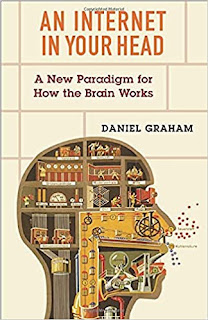
An Internet in Your Head: A New Paradigm for How the Brain Works. Daniel Graham. 2021. Columbia University Press. [ISBN 978-0-231-19604-8. 344 pages, including index. US$30.00 (hardcover).]

“But metaphors—and especially technological metaphors—have been critical in the history of science, and they will continue to be so as we get closer to understanding the brain” (p. 27). Even before modern technology allowed us to use tracers and imaging techniques on the brain, philosophers and scientists used metaphors to encompass the intricacy and complexity of this critical organ. Seventeenth century philosopher René Descartes likened the brain to the plumbing behind the grand waterworks of the Palace of Versailles—water was pumped uphill from a nearby river—and artfully expelled several meters high on display—delivering more water than was supplied to all of Paris. Building upon this premise, Nobel Prize winner Charles Sherrington likened neurons to “valve-like” structures. Charles Darwin, famous for his work on evolutionary theory, was unable to conceptualize the brain, partly because he had no metaphor for it. He believed thoughts were secreted by the brain, like digestive chemicals. Gottfried Leibniz, co-inventor of calculus, suggested the brain was a type of mill—this suggests different processes operating at different levels. This morphed into the modern-accepted metaphor of the brain as a computer.

In An Internet in Your Head: A New Paradigm for How the Brain Works, computational neuroscientist Daniel Graham argues that although the computer metaphor for the brain is helpful and somewhat accurate, it is ultimately obsolete. Many current research observations and discoveries suggest an organ more akin to a network communicator, or an Internet. “There is no doubt that the computer metaphor has been helpful and that the brain does perform computations. But neuroscience based on the computer metaphor is incomplete because it does not consider the principles of network communication. Neuroscientists are starting to realize that, in addition to performing computations, the brain also must communicate within itself” (p. viii).

Graham cites experimental evidence for the flaws in the computer model: In a controlled study of monkey brains compared with a deep net artificial intelligence system, the deep net system predicts less than half of the neuron activity over time. Besides showing the inadequacy of a deep net, this experimental evidence suggests the system is missing the most important signals occurring in the monkey brains.

For the rest of An Internet in Your Head, Graham provides a comprehensive analysis of the ways in which the Internet does and does not correlate to what scientists currently understand about the functionality of the brain. Flexible routing, asynchronous communication, management of errors, background noise, overall growth of the network (and other phenomena) can all be explained in more depth by an Internet-like structure rather than by a computer. Graham argues that a structure of multiple hubs connected in multiple ways creates a net of communication on many different levels. A problem with his analysis is that some of the vocabulary and experimentation is very specific to the field and an understanding of both electronics and neuroscience seems required to follow all the arguments.

And ultimately, scientists don’t have the ability to experiment with the brain’s inner workings. “Many of the limitations are procedural: it boils down to the fact that living brains, particularly human brains, are difficult to study, whereas single neurons are tractable” (p. 67).

Julie Kinyoun

Monday, November 15, 2021

About Us: A Book Review

 About Us: Essays from the Disability Series of The New York Times Peter Catapano and Rosemarie Garland-Thomson, eds. 2021. [ISBN 978-1- 63149-858-9. 286 pages. US$18.95 (softcover).] 


    It is obvious that usability and accessibility drive technological innovation and advancement. Not so conspicuous is the source of this usability. For example, many are surprised to hear that the original touchscreen technology of the iPhone was purchased by Apple’s Steve Jobs in 2005 from an electrical engineering student sustaining injuries that interfered with his ability to study and work. Many do not know that the updated kitchen products engineered by the Oxo were the original design of a woman unable to work in the kitchen due to her arthritis. A Nuremberg-based watchmaker, also a paraplegic, created the first self-directed wheelchair which was the precursor to the modern bicycle. Or that curb cuts originated with disgruntled wheelchair users in Berkeley, CA. Later curb cuts became universal because they helped strollers, bicycles, baggage handlers, and anybody else navigating wheels. 

It is these inspirational stories with which we can relate and that make About Us: Essays from the Disability Series of The New York Times so relevant to the technical world. And yet beneath the inspirational stories of lifechanging technology, there is humanity—heartache, struggle, alienation, and loneliness. The challenges with daily problems and the striving to maintain an outlook of positivity are also relevant to the technical world. 

In this collection, editors Peter Catapano, Opinion Editor for the New York Times, and Rosemarie GarlandThomson, disabled English professor at Emory University, compiled about 60 essays from the New York Times’ groundbreaking series on disability. Their intent was to include a wide variety of people—different ages, disabilities, outlooks, and experiences. Their goal of inclusion is explained, “By ensuring that people with disabilities tell their own stories, we intend to avoid and counter the sort of biased, simplified, often demeaning portrayals of them that are produced by an American popular culture designed by and for the nondisabled” (p. xx). 

These essays, first published starting in August 2016, are organized in seven sections: justice, belonging, working, navigating, coping, love, family, and joy. By sorting experiences according to these topics, three overall disability challenges are conveyed: inherent challenges, access challenges, and social challenges. Underlying all this is the idea that the American Disabilities Act (ADA) of 1990, while progressive in many ways, was just a small step forward in necessary changes required for people of all disabilities to be integrated into our society. Mentioned at least twice throughout the text is the offensive 1927 Supreme Court decision in which Oliver Wendell Holmes declared, “It is better for all the world, if instead of waiting to execute degenerate offspring for crime, or to let them starve for their imbecility, society can prevent those who are manifestly unfit from continuing their kind. Three generations of imbeciles are enough” (p. ix). That such a statement was ever made in such a context demonstrates misguided public opinion both past and present. 

These first-hand accounts of experiences and obstacles in the lives of disabled people open a glimpse into their worlds. It is through these rare glimpses that we can hope to bridge more of the gap between what the American Disabilities Act aimed to achieve and the realities of change and progress in our increasingly technological world. 

Julie Kinyoun Julie Kinyoun is an on-call chemistry instructor at various community colleges in Southern California. An avid reader, she enjoys reviewing books that help her become a better educator.

Wednesday, August 25, 2021

Goldiblox- STEM for girls.

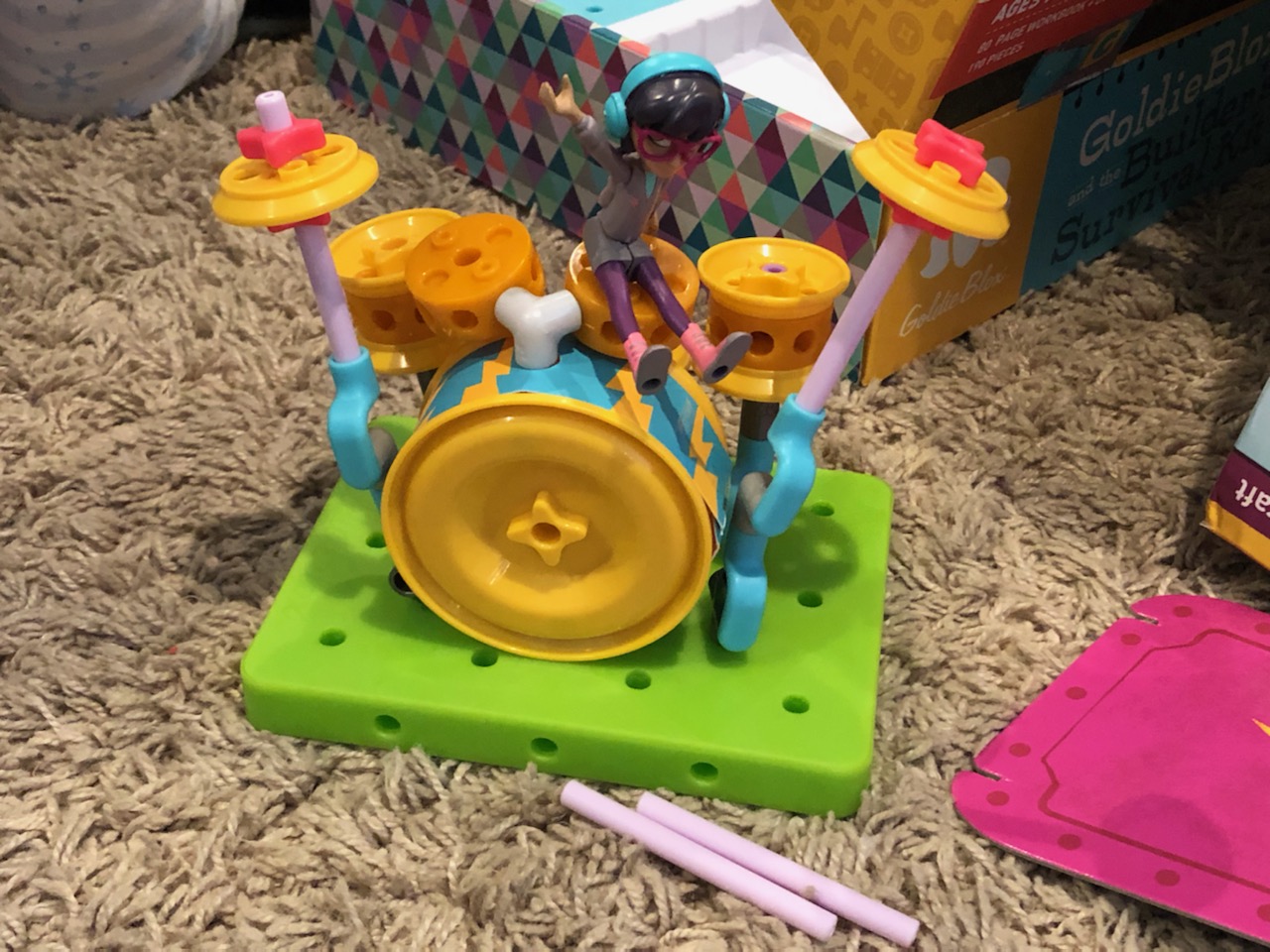
 My girl engineers were busy this weekend- they made THIS!

These projects from Goldiblox are the ultimate in engineering for girls. Each comes with a story- it is thought that making science about a story will engage more girls in the subject. This particular project is a drum set for Valentina (one of the Goldiblox characters).


Here is a copy of the instructions for one of the projects- a car. The entire kit is the largest one I have seen- you can make more than four different projects from it- including the drum set and this car and the ice cream truck pictured below. We made the ice cream truck and witnessed the ice cream sign above the vehicle rotate around in a circle when the wheels rotate. Most projects feature something like this.


It’s really too bad these are discontinued because my girls have spent hours studying the directions and putting these kits together. The skill development in these exercises is irreplaceable. They love them. And they are PINK! 
Go girl engineers!


Saturday, August 14, 2021

The organization of organisms….


https://www.economist.com/schools-brief/2021/08/12/how-organisms-are-organised


Here is chemistry in action. This article describes and summarizes the functions of organs- many are driven by underlying chemical gradients. The picture shows a plant and its functions (driven by a membrane chemical process shown) and a neuron- a basic component of an animal brain. Chemicals are not shown for delivery of messages on an axon, however, they are implied by the word “action potential” which implies an electrical process of some kind.

Chemistry is critical for the functioning of all living creatures.

Friday, July 30, 2021

Book Review: Understanding Clinical Papers

Understanding Clinical Papers

David Bowers, Allan House, David Owens, and Bridgette Bewick. 2021. 4th ed. Wiley Blackwell. [ISBN 978-1-119-57316-6. 290 pages, including index. US$50.00 (softcover).]

As we navigate the post pandemic world of vaccines and global health awareness, an understanding of clinical studies becomes relevant to all people, whether formally educated in research studies or not. The study of an idea/product/process on human subjects in a clinical trial is the final step before something is introduced into human society. This complex process is outlined in Understanding Clinical Papers written by both quantitative and qualitative experts in their respective clinical fields: David Bowers, Allan House, David Owens, and Bridgette Bewick.

This book now in its fourth edition is a comprehensive, detailed account of how to read and understand both qualitative and quantitative clinical research. For anyone who wrote labs in school many of the headings and chapters will be familiar. The book’s unique characteristics arise from a collaboration between four researchers with different areas of clinical specialization. Since the first edition was published more than twenty years ago, the authors have added entire chapters in new statistical analyses for study results and qualitative research. Much of the initial setup and results analysis differs between qualitative and quantitative research, and it is noticeable to have both analyzed and even synthesized together in current clinical research projects.

The first half of Understanding Clinical Papers explains the study design, research subjects, results identification, and methods of measurement. Initially, a reader will check superficial outcomes of the study: Are the results significant, is it worth reading, is it relevant and is it ethical? How do the researchers layout their initial hypothesis—or if not investigating a hypothesis—is it clear what new ideas or questions they are trying to generate for the future? Throughout the text, the authors use an effective technique of illustrating a particular concept—a segment of a clinical paper is featured as a numbered table/figure with text bubbles and arrows. The text bubbles are connected with arrows to specific sections of the table/figure where the topic of interest is used in the clinical research. In this way, a relevant example of the featured topic is shown from current clinical literature.

The second half of the book covers results analysis and the complexities of statistical significance. In this section, some advanced knowledge of mathematics and statistics is helpful as the clinical data have often been subjected to a computerized statistical analysis. The authors sum up the confusion of interpreting statistical analysis in the statement, “If you have trouble figuring out what it tells you, do not worry: no-one else can do any better than you” (p. 162). This refers to the use of odds ratios to explain results used primarily for the mathematical properties that are beyond the book’s scope. Knowing this, the explanation of the p-value, a critical component of making results “significant” helps us understand just how complex statistical analysis really is, “How then do we decide what constitutes strong enough evidence against the hypothesis to enable us to reject it? The evidence we use is a probability, known as a p-value. The p-value is the probability of getting any particular outcome ...when the hypothesis is true” (p. 182). Overall, the second half of the book outlines different clinical scenarios, their results analysis, and the interpretation of their p-values and derivatives.

Impressive that Bowers, et al, was able to incorporate such an all-encompassing topic in 273 pages plus an eight-page reference section and a nine- page index. It is detailed enough for an experienced researcher yet realistic for an ambitious, educated layperson wanting to better understand clinical research. A must-have for the shelves of health-care professionals and health-care enthusiasts of all levels.

Julie Kinyoun

Julie Kinyoun is an on-call chemistry instructor at various community colleges in Southern California. An avid reader, she enjoys reviewing books that help her become a better educator.


Sunday, June 06, 2021

Familiarity breeds interest- accessibility and modern culture


 http://www.brianglenney.com/accessible-icon-project

My current project is to review a collection of essays about people with disability. I selected it off of a list of available books thinking, “disability is now part of my experience.” During my time of “disability” I would not have wished the experience on anybody- the unmet needs, isolation, frustration with the system….it was all just hard. Not hard but excruciating. But now that it is over and I am back to my old athletic self, I think everybody should spend some time simulating the experience. It changed my opinions on “accommodations” and how I view people with disabilities. Disability can happen to anybody at any time- it might be temporary (like mine) or it might be permanent. Whichever it is, it is debilitating, humiliating and beyond humbling.

I broke my foot. Not just at any time in life. I broke my foot during a time in life with two small babies (a baby and a 2.5 year old to be exact). Trying to load and unload my car, enter buildings with (or even without) my stroller, and just trying to do everyday things like get dressed, use the restroom and care for my children became unmanageable tasks. My husband was downtown working during the day most of the time and although he was wonderful when he was home, he was not able to help when we were doing our daily routine. The other thing about my broken foot was that it was a minuscule bone on the top of my right foot-not important enough to warrant crutches or an official “disability” parking placard. (But without a proper healing the injury would turn into something much, much worse.) It was just a nuisance of putting a boot on to walk and then changing back into my shoe to drive my car. But- this didn’t mean I could load and unload a 25-pound stroller from my trunk or get my baby/toddler out of the car seat.

So I was excluded- from play dates, from other social opportunities, and almost from the daily preschool routine. With my boot on/off routine, a baby in a car seat (who was not walking) and a 3-year-old with no sense of self, it took me an hour to load and unload my car. And for what? To drop my 3-year-old off at preschool. Only to return three hours later and do it again. All while breastfeeding a young baby and trying to care for her. 

Here is what saved me being institutionalized as “crazy.” Disability parking without a disability placard.

Our preschool installed a parking lot near the only entrance for women in exactly my condition. There were about twenty available spaces where you could park up against a perfect paved curb and enter the building about ten feet away. The other lot required me to walk two long hallways and navigate an elevator. I chose the twenty spots near the door. It also helped that the director noticed my condition and sent a designated parking attendant out to my car every day to do a special drop off/pickup service. I wasn’t even getting out of my car for drop off and pickup. Did I have to ask for this? No, they volunteered. That preschool has a reputation for accommodating situations like this- I was only vaguely familiar with this when we registered. Little did I know that it would save my sanity.


So back to the wheelchair/disability symbol. While my parking lot did not have these placards, the spots were understood to be for people with impediments- many small children, being pregnant and not wanting to walk far, or people in my condition with an injury. The lot’s purpose was obvious in an environment with young families.  But -most of the time such a lot needs to be marked- with a recognizable sign.

Which brings me to the accessibility symbol- Brian Glenney and his team updated this back in 2011 to depict the wheelchair occupant as active, not passively sitting in a chair. This is so much more representative of what it means- and so much more respectful of the people using it. Young families with children are very active, young and formerly active people who are injured…. even people permanently disabled are active in ways we can’t imagine because we haven’t experienced what they do. All of these scenarios fit within the purpose of this placard.

Let’s use the updated placard with pride- legalize it and formalize its use. Disability/accessibility accommodations are not for passive participants - we are active and involved citizens. I can say “we” because I was one of them.

Sunday, April 25, 2021

Sometimes it just takes a small group to start.....

 Sometimes, all it takes is ONE. There is a children’s book with this theme. One color is being bullied by another color and all the other colors get smaller and smaller as the bullying gets worse and larger. Then, ONE comes along and forms a support network for 2, 3, 4, 5, 6 and 7. Finally, as the bully realizes the group is stronger together, he/s pops and becomes number 8- part of the support network. 


This came to mind today as I arrived to help out with food distribution at a local affordable housing complex. A small group of woman banded together and formed a support network designed to provide for the growing needs of the lower income population- those living in affordable housing complexes. These are probably the most likely people to become homeless. These organizers are thorough. When I arrive for food distribution I just stand around and watch and take directions- they have left no stone unturned. Many who show up for the fresh food- donated before expiration from local grocers- are elderly and many do not speak English. Helping these people carry food to their apartments is often my job.  But today- I found another one. Last Thanksgiving I sponsored a family for Thanksgiving. Many grocery stores offer premade holiday meals for people unable to cook. The commitment was just for a meal. However, today someone told me they were planning to drop off an item for a family they met through the program. I asked how they knew the person and they told me through the Thanksgiving sponsorship. Bingo! I found a job- I filled a bag full of the produce from overflowing boxes of fruit and vegetables- so abundant the leftovers will rot before it reaches a hungry person- and dropped it on her porch. She texted me back with praise and thanks- very helpful for her right now in her strapped financial situation. It would never have occurred to me to do this simple, inexpensive gesture of kindness without the idea from my friend. A single bag full of fresh fruit/vegetables is not what most of us consider “a treat” (from her text message).

I find many times it just takes one or two people to start a waterfall. In this case, alleviating hunger. And it is getting worse- the Union Tribune reported that homelessness has doubled in 2020. And now we are in 2021- that statistic was not quoted.

Maybe others will show up, fill a bag and drop it at the home of someone strapped for cash. Seriously, before it ends up rotten in a landfill. Sometimes even the smallest act of kindness can save someone. All it takes is ONE.


Friday, April 09, 2021

Just Keep Moving....

A family photo at the top and individual pictures on the exact day of someone’s birthday


 The spring brings flowers, showers, sunshine, new life and re-emerged beauty from the blandness of winter. It also brings a large swath of birthdays in my extended family. For me this timing seems to certify the reality of spring- the long empty winter has ended and the outdoor parties have begun. Turning a year older brings a newness that suggests possibility, room to grow, and fresh goals.

One of the ways we recognize these milestones in my family is with a calendar of photos from the previous year. Someone in the family designates themself as the person in charge- for many years this was my mother. Then, everybody sends that person their favorite pictures taken since the previous year. Traditionally this process took place in the fall because we presented the calendar to my grandmother in her nursing facility for Christmas. However, my grandmother passed away almost ten years ago and we have continued the tradition without her- because it creates such a piece of art for family historical records.

Since my grandmother passed away, the person in charge has changed a bit- I’ve done it a few times and some of my aunts volunteered. Every Christmas, the person in charge sends out an artistically arranged calendar for the kitchen/living room wall. It used to be targeted for Grandma, now a copy is sent to everyone involved. Every day our favorite memories are displayed in front of us for nostalgia- to remember how lucky with are to have each other and the support of a wonderful family. It is also so that everybody knows exactly which day to send out birthday cards. I learned that putting someone’s picture on the little square that represents their birthday really does make a difference- the visual seems to prompt me to send a card. With just the words “Mom’s Birthday” it is easy for the eyes to gloss over the event that day- the picture makes it ostentatiously advertised each time I see it on the wall. With a photo reminder, I cannot forget that person’s birthday.

Every birthday, just like every New Year’s Eve, brings the possibility for change, and for reflection. I like my father’s advice- “Just keep moving, don’t stop.” This applies to when you are on a winning streak- perhaps collecting qualifying events for the next level of swimming championship, playing the piano for a scholarship, or running a 5K race. It’s easy to keep moving when things are going well. When things are hard it is even more important to keep moving- you don’t want to stay stuck in the place where things are hard. Finish something that is hard- move through it and bring it to completion. Then, try to take on a project that perhaps brings more success. But don’t stop moving. And while you are moving keep a point of inspiration in front of you- in my case the family calendar. Somehow-looking at those photos on my wall gives me the inspiration to keep moving- not just when things are going well.

Good quotation


“Failure after long perseverance is much grander than never to have a striving good enough to be called a failure.” -- George Eliot, Middlemarch

Saturday, February 20, 2021

Tools of the Trade: Technical Communication Book Review Series

Tools of the Trade

 Review of Three Books on Science Writing

By Julie Kinyoun

INTRODUCTION

Among scientists, communication is a critical component of individual and corporate success; among laypeople, science communication is the conduit to a society more positioned to make educated, informed decisions. The intersection of these two cultures is a middle ground of concerned citizens who realize there is an increasing gap between the assumptions, general knowledge, and expectations of the two groups. As scientists struggle to publish data, win grant money, and maintain their respect with the public, the rest of us must attempt to run daily lives with some awareness of how science affects our very being: from the energy use in our homes and cars, to the medicines and foods we feed our children, and the choice of how to vote in public elections.

Many of our seemingly mundane, everyday choices and actions are influenced, to a certain degree, by basic science. It becomes more important that people at all educational levels have access to informed, accurate, and honest analyses of data created from scientists of integrity. To this end, three short books were written by authors of varying scientific backgrounds on the same topic: how to think and write about science in a clear, communicable and appealing way for increased funding, efficient collaboration, respect, prestige, and public awareness.

SCIENTIFIC WRITING = THINKING IN WORDS, SECOND EDITION

This 166-page book covers every section of a scientific paper in almost excruciating detail, perfect for a beginner. It would also be useful for scientists who are English language learners or for a scientist who was trained before the digital explosion of the last 20 years.

David Lindsay explains in the Preface the need for updates to his 2020 book. Aside from the more global focus resulting from the electronic era, he acknowledges some progress from the mentality of research writing from the Preface in his 2010 edition, “It means that the over-formal and often pretentious style of older writing that made writing challenging for researchers is now more relaxed and less threatening for native and non-native English speakers alike . . . In short, people are recognizing that being understood is far more important than being impressive” (p. vii). Lindsay is a researcher himself, which is abundantly clear as he walks his readers through the process of a scientific paper: from formulating the original hypothesis to submitting it to a journal—this is the first 100 pages of the book. Other important science communication responsibilities of a scientist are in the last section and include oral presentations, posters, literature reviews, theses, and grant proposals. One tiny chapter near the end focuses briefly on science communication for a lay audience.

If a scientist is presenting or submitting research for the first time, Scientific Writing = Thinking In Words would be an excellent springboard from which to launch.

THE SCIENCE OF COMMUNICATING SCIENCE: THE ULTIMATE GUIDE

In contrast to David Lindsay’s approach, Dr. Craig Cormick approaches science writing from the perspective of a journalist. His focus is on communicating science to an increasingly distrustful public who view science from a skeptical glance. Each chapter begins with a pithy quotation from  a famous person, movie or book that introduces his main point for that chapter. This is a brilliant strategy to demonstrate a point that weaves its way throughout the entire book: science is part of everything we do.

In his chapter specifically about politics and policy, he starts with a quotation by Maureen O’Neil, former President and CEO of International Development and Research Centre. “In development research, to get a new discovery into policy and practice is just as important as the discovery itself” (p 132). In communicating science, you should gauge the likelihood that your audience will value and respect the data and conclusions you are presenting. Success in conveying a message will largely rely on an understanding and ability to gear that message to the values of a given audience.

Cormick’s focus on metaphors, simple illustrations, storytelling, and use of media is the strategy of how he proposes to win the public to a science perspective. Unfortunately, he assumes that the world of scientists is always correct and does not propose ways of testing that credibility. Another drawback of his approach is that if you want a quick reference, you must sift through his storytelling and interweaving of topics to get to a main point. For this reason, it is not particularly useful for a beginner. The audience for The Science of Communicating Science: The Ultimate Guide is a rather narrow group of people who already grasp basic science and have at least dabbled in science communication. His own skepticism is slanted toward the public and he omits an examination of the quality of the science when looking at effectiveness of science communication. This book is for you if you are confident of your scientific message and want to learn how to effectively convey it.

THE CRAFT OF SCIENCE WRITING: SELECTIONS FROM THE OPEN NOTEBOOK

This nearly 300-page book is a compilation of essays, interviews, step-by-step instructions, and other writing tidbits compiled on a web site called “The Open Notebook” founded in 2010 by Siri Carpenter. What developed into an online science writing community started as a web page run by two graduate students interested in transitioning their bench science careers into science writing.

The Craft of Science Writing: Selections from The Open Notebook is divided into five parts: becoming a science journalist, finding science stories, reporting science stories, Storytelling, and building expertise in your subject. Each chapter within a section is written by a specialist explaining their area of expertise. One difference between this book and other books geared toward science advocacy/lobbying is that amongst the storytelling and appeal of science journalism, this community holds a healthy skepticism toward scientists themselves.

Three chapters of the nearly 40-chapter book cover topics specifically related to making sure the science being reported is sound science. “How to Read a Scientific Paper,” “What are the Odds,” and “Spotting Shady Statistics” allude to the idea that before reporting a new study it is important to examine the science and even read the published paper. Sometimes the scientists themselves are at fault in disseminating poor information—whether in just faulty analyses and conclusions or even, in some cases, shady and dishonest results.

In the end, The Craft of Science Writing reads like a guest-artist feature in every aspect of science journalism. This book would be an excellent addition to a graduate program in any science subject or even a small-group journal club for undergraduates.

REFERENCES

Carpenter, S., ed. (2020). The Craft of Science Writing: Selections from The Open Notebook. The Open Notebook. [ISBN 978-1-7340280-0-3. 288 pages. US$24.95 (softcover).

Cormick, C. (2019). The Science of Communicating Science: The Ultimate Guide. CSIRO Publishing. [ISBN 978-1-4863-0981-8. 256 pages. US$39.95 (softcover).]

Lindsay, D. (2020). Scientific Writing = Thinking in Words, 2nd ed. CSIRO Publishing. [ISBN 978-1- 4863-1147-7. 180 pages. US$24.50 (softcover).]

 Volume 68, Number 1, February 2021 l Technical Communication 87