Tuesday, March 08, 2022

Being a Mom


Recently I processed my infant-mothering days from the rear-view mirror by compiling an album for the family of a friend. It was for the family of this friend and not the friend herself because my friend died. Yes, my forty-year-old, “younger” friend died of colon cancer. Sigh. That is a different blog post. 

On the cover of the album is a beautiful photo of six soul sisters- six women who banded together and shared maternity and baby clothes, birthday and pool parties, holiday cookie exchanges and weekly play dates at people’s homes and at local parks. We are all calmly smiling for a perfectly posed picture of a perfect friendship because we had just sailed carefree through motherhood together….. NOT! I look at these six women (and two toddlers who unknowingly photobombed our picture by running to mommy) and I know we were tired, we had just disagreed about the time and location of our picnic and some of us had done a separate party with alcohol the night before. That is why this cover photo is unique- never before had someone (my parents in this case) gotten us organized for such a picture. The rest of the 50 assorted photos of these women include one or more of us as dots in the background, serving food, speaking to a child while holding a plate and balancing a baby in the other arm. Truthfully most of the pictures are just of the kids- playing at the park, eating, blowing birthday candles, and posing for mom saying “smile for a picture honey.” 
You can’t survive motherhood alone. Period. With a brand new baby I showed up at mommy events designed for the isolated, family out-of-town mother to bond with other moms only to be asked to work in childcare (What?) or to meet women who lived an hour’s drive across town or just to leave feeling rejected in some way. Wasn’t I the pretty, involved, musically talented teenager who qualified for a highly-select college with professionals at the highest level of accomplishment? What happened to popular me? Now I was the slightly pudgy (from pregnancy), perpetually tired, slightly out-of-fashion maternity clothes who was always asking for a babysitter. People started to avoid me when I would arrive. What is she asking for now? I was thinking THEY were thinking.

So to find a group of women who wanted to share these moments was inner-soul soothing. Being accepted on the raw level of something never experienced- being in a low, vulnerable place and having other women surround me and say “we are here too.” Not perfect but definitely critical. I recently told the sister of my deceased friend:  Mothering is the hardest thing you will ever do. People you thought were your friends will disappear and let you down. You will feel alone. You will feel rejected or not good enough or lonely. You will show up at the park with your baby only to feel left out by the elementary-school aged moms who all know each other from soccer league. You will sit with your baby, not knowing anybody, and nobody will introduce themself to you. They look right through you. They do not need a woman with a baby nor is a woman with a baby of any use to them. You are a nuisance. You are an extra responsibility. You are a person always looking to shift responsibility onto others. And it doesn’t matter if that is not who you are- people will make you feel that way.

The album for my friend’s family is called “Good Times.” Our smiles in these select twenty photos don’t reveal our exhaustion, our health problems, our recent fight with our spouse, our disagreements or disappointments with each other, our own insecurities with our body image, relationships and extended family. But we survived and even overcame and thrived despite these things partly because we found each other. Closer with some women at certain times than others- that too changed as time went by. The woman with whom I currently communicate most was probably the woman I knew the least at the time of the photo. Now our kids play on the same sports teams and we see each other frequently. Of the other four, one lives in an adjoining neighborhood and we occasionally bump into each other on a walk, two moved out of the country (and then one of those died), and one lives a few miles away with kids at different schools and in different activities (she has boys and I have girls). Our lives has drastically changed since this photo was taken. We no longer need each other the same way. But speaking for myself- I don’t know what I would have done without this support group when my girls were babies.

All of the women in this tribe shared a few characteristics: our families were all out-of-town, we were all married to highly educated men who primarily worked in the high-tech industry, we had all graduated from college and worked at a job. And most of us had some serious hobbies with which we could throw ourselves into during the drudgery of motherhood.
It was drudgery that nobody could have prepared me for. No amount of babysitting, educational observations, or other preparation would have made a difference. It was sink or swim. 

Together we swam. That swim propelled us out of the world of babies and toddlers into the world of older children where we currently stand. We were a team.



Saturday, February 12, 2022

Book Review on the Subconscious Brain


Subconsciousness: Automatic Behavior and the Brain. Yves Agid. 2021. Columbia University Press. [ISBN 978-0-231-20127-8. 110 pages, including index. US$26.00 (softcover).]

Subconsciousness: Automatic Behavior and the Brain delves into the poorly understood connection between structure and function in the brain-particularly regarding intentional and unintentional behavior. Yves Agid discusses this obscure subject in a 100-page treatise that links the cerebral cortex with the basal ganglia and argues that intentional and unintentional behavior arise from the engagement and disengagement of neural pathways in between. The author clarifies early in his book that subconsciousness is not the Freudian concept of the unconscious mind—primarily repressed mental content that affects behavior. Subconsciousness is not easily discernible, in contrast to the clear sense of consciousness or meta- consciousness. He narrates a first-person account of a traffic jam in Paris—noting the intentional decisions (consciousness) and self-talk (meta-consciousness) during each event in traffic. Autopilot—driving without intentionally thinking about choices and actions—is the work of the subconscious. Later in the book, Agid asks the question that if the brain is operating on autopilot, is it possible to decide (like when driving) without being aware that a decision was made? (The answer is yes). Herein lies some of the complexity of the subconscious.

Text boxes are one method of highlighting important discoveries toward the link between structure and function in the brain. These pull-out boxes summarize case studies with significant outcomes. Box 4.3, for example, describes the famous psychiatrist Sigmund Freud’s rotation in a neurology department (pp. 82–83). This famous neurology research lab studied lesions in various parts of the brain. After death, an autopsy of the spinal cord and brain linked patient behavior while they were alive to the functionality of their brain postmortem. This early work led to the belief that links behavior to the health of various pathways in the different sections of the brain. It is important to note that although Agid strongly argues that the basal ganglia are primarily responsible for the brain’s subconscious functions, it is very much in collaboration with the cerebral cortex. “The basal ganglia are faithful collaborators of the cerebral cortex . . . They are not alone, isolated, and cut off from the rest of the brain, as they involve the cerebral cortex every time they are activated, just as they are activated every time the cerebral cortex drives deliberate behavior” (p. 72). It is a feedback loop of sorts. This description is, of course, a simplification of the extremely complex process occurring. “One might say that this is a caricatured reductionist perspective” (p. 72).

Agid devotes an entire chapter to a discussion about deficiencies in the structure of the brain and how those correlate to functionality. Two diseases that illustrate this well are Alzheimer’s and Parkinson’s. In Alzheimer’s disease the patient has problems related to memory, language, and perception, all controlled by the cerebral cortex while with Parkinson’s the patient cannot perform routine tasks like brushing teeth, walking, and writing—all controlled by the basal ganglia. “These two pathologies are somehow mirrored, which suggests, but does not demonstrate, that the cerebral cortex plays a predominant rule in nonautomatic behaviors, and conversely, that basal ganglia dominate in automatic behaviors (p. 57).

Perhaps because it is unavailable, information is not given to directly support brain scans and the Alzheimer’s/cerebral cortex link versus the Parkinson’s/ basal ganglia link. However, this lifelong researcher in the field of neurology and behavioral science seems convinced that link is probable.

Julie Kinyoun

Book Review: A New Metaphor for the Brain


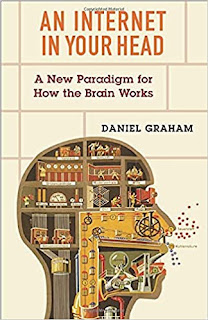
An Internet in Your Head: A New Paradigm for How the Brain Works. Daniel Graham. 2021. Columbia University Press. [ISBN 978-0-231-19604-8. 344 pages, including index. US$30.00 (hardcover).]

“But metaphors—and especially technological metaphors—have been critical in the history of science, and they will continue to be so as we get closer to understanding the brain” (p. 27). Even before modern technology allowed us to use tracers and imaging techniques on the brain, philosophers and scientists used metaphors to encompass the intricacy and complexity of this critical organ. Seventeenth century philosopher RenĂ© Descartes likened the brain to the plumbing behind the grand waterworks of the Palace of Versailles—water was pumped uphill from a nearby river—and artfully expelled several meters high on display—delivering more water than was supplied to all of Paris. Building upon this premise, Nobel Prize winner Charles Sherrington likened neurons to “valve-like” structures. Charles Darwin, famous for his work on evolutionary theory, was unable to conceptualize the brain, partly because he had no metaphor for it. He believed thoughts were secreted by the brain, like digestive chemicals. Gottfried Leibniz, co-inventor of calculus, suggested the brain was a type of mill—this suggests different processes operating at different levels. This morphed into the modern-accepted metaphor of the brain as a computer.

In An Internet in Your Head: A New Paradigm for How the Brain Works, computational neuroscientist Daniel Graham argues that although the computer metaphor for the brain is helpful and somewhat accurate, it is ultimately obsolete. Many current research observations and discoveries suggest an organ more akin to a network communicator, or an Internet. “There is no doubt that the computer metaphor has been helpful and that the brain does perform computations. But neuroscience based on the computer metaphor is incomplete because it does not consider the principles of network communication. Neuroscientists are starting to realize that, in addition to performing computations, the brain also must communicate within itself” (p. viii).

Graham cites experimental evidence for the flaws in the computer model: In a controlled study of monkey brains compared with a deep net artificial intelligence system, the deep net system predicts less than half of the neuron activity over time. Besides showing the inadequacy of a deep net, this experimental evidence suggests the system is missing the most important signals occurring in the monkey brains.

For the rest of An Internet in Your Head, Graham provides a comprehensive analysis of the ways in which the Internet does and does not correlate to what scientists currently understand about the functionality of the brain. Flexible routing, asynchronous communication, management of errors, background noise, overall growth of the network (and other phenomena) can all be explained in more depth by an Internet-like structure rather than by a computer. Graham argues that a structure of multiple hubs connected in multiple ways creates a net of communication on many different levels. A problem with his analysis is that some of the vocabulary and experimentation is very specific to the field and an understanding of both electronics and neuroscience seems required to follow all the arguments.

And ultimately, scientists don’t have the ability to experiment with the brain’s inner workings. “Many of the limitations are procedural: it boils down to the fact that living brains, particularly human brains, are difficult to study, whereas single neurons are tractable” (p. 67).

Julie Kinyoun

Monday, November 15, 2021

About Us: A Book Review

 About Us: Essays from the Disability Series of The New York Times Peter Catapano and Rosemarie Garland-Thomson, eds. 2021. [ISBN 978-1- 63149-858-9. 286 pages. US$18.95 (softcover).] 


    It is obvious that usability and accessibility drive technological innovation and advancement. Not so conspicuous is the source of this usability. For example, many are surprised to hear that the original touchscreen technology of the iPhone was purchased by Apple’s Steve Jobs in 2005 from an electrical engineering student sustaining injuries that interfered with his ability to study and work. Many do not know that the updated kitchen products engineered by the Oxo were the original design of a woman unable to work in the kitchen due to her arthritis. A Nuremberg-based watchmaker, also a paraplegic, created the first self-directed wheelchair which was the precursor to the modern bicycle. Or that curb cuts originated with disgruntled wheelchair users in Berkeley, CA. Later curb cuts became universal because they helped strollers, bicycles, baggage handlers, and anybody else navigating wheels. 

It is these inspirational stories with which we can relate and that make About Us: Essays from the Disability Series of The New York Times so relevant to the technical world. And yet beneath the inspirational stories of lifechanging technology, there is humanity—heartache, struggle, alienation, and loneliness. The challenges with daily problems and the striving to maintain an outlook of positivity are also relevant to the technical world. 

In this collection, editors Peter Catapano, Opinion Editor for the New York Times, and Rosemarie GarlandThomson, disabled English professor at Emory University, compiled about 60 essays from the New York Times’ groundbreaking series on disability. Their intent was to include a wide variety of people—different ages, disabilities, outlooks, and experiences. Their goal of inclusion is explained, “By ensuring that people with disabilities tell their own stories, we intend to avoid and counter the sort of biased, simplified, often demeaning portrayals of them that are produced by an American popular culture designed by and for the nondisabled” (p. xx). 

These essays, first published starting in August 2016, are organized in seven sections: justice, belonging, working, navigating, coping, love, family, and joy. By sorting experiences according to these topics, three overall disability challenges are conveyed: inherent challenges, access challenges, and social challenges. Underlying all this is the idea that the American Disabilities Act (ADA) of 1990, while progressive in many ways, was just a small step forward in necessary changes required for people of all disabilities to be integrated into our society. Mentioned at least twice throughout the text is the offensive 1927 Supreme Court decision in which Oliver Wendell Holmes declared, “It is better for all the world, if instead of waiting to execute degenerate offspring for crime, or to let them starve for their imbecility, society can prevent those who are manifestly unfit from continuing their kind. Three generations of imbeciles are enough” (p. ix). That such a statement was ever made in such a context demonstrates misguided public opinion both past and present. 

These first-hand accounts of experiences and obstacles in the lives of disabled people open a glimpse into their worlds. It is through these rare glimpses that we can hope to bridge more of the gap between what the American Disabilities Act aimed to achieve and the realities of change and progress in our increasingly technological world. 

Julie Kinyoun Julie Kinyoun is an on-call chemistry instructor at various community colleges in Southern California. An avid reader, she enjoys reviewing books that help her become a better educator.

Wednesday, August 25, 2021

Goldiblox- STEM for girls.

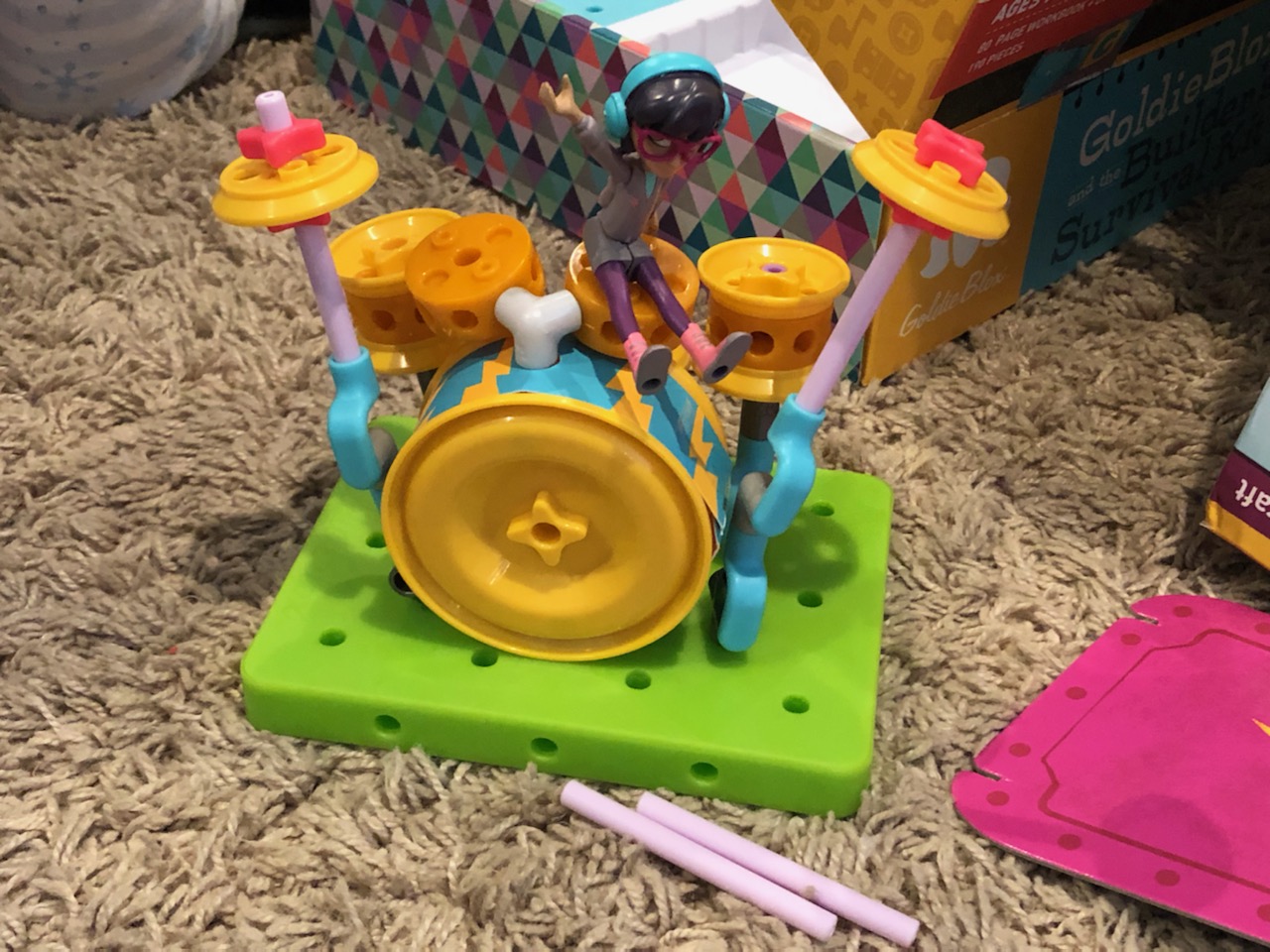
 My girl engineers were busy this weekend- they made THIS!

These projects from Goldiblox are the ultimate in engineering for girls. Each comes with a story- it is thought that making science about a story will engage more girls in the subject. This particular project is a drum set for Valentina (one of the Goldiblox characters).


Here is a copy of the instructions for one of the projects- a car. The entire kit is the largest one I have seen- you can make more than four different projects from it- including the drum set and this car and the ice cream truck pictured below. We made the ice cream truck and witnessed the ice cream sign above the vehicle rotate around in a circle when the wheels rotate. Most projects feature something like this.


It’s really too bad these are discontinued because my girls have spent hours studying the directions and putting these kits together. The skill development in these exercises is irreplaceable. They love them. And they are PINK! 
Go girl engineers!


Saturday, August 14, 2021

The organization of organisms….


https://www.economist.com/schools-brief/2021/08/12/how-organisms-are-organised


Here is chemistry in action. This article describes and summarizes the functions of organs- many are driven by underlying chemical gradients. The picture shows a plant and its functions (driven by a membrane chemical process shown) and a neuron- a basic component of an animal brain. Chemicals are not shown for delivery of messages on an axon, however, they are implied by the word “action potential” which implies an electrical process of some kind.

Chemistry is critical for the functioning of all living creatures.

Friday, July 30, 2021

Book Review: Understanding Clinical Papers

Understanding Clinical Papers

David Bowers, Allan House, David Owens, and Bridgette Bewick. 2021. 4th ed. Wiley Blackwell. [ISBN 978-1-119-57316-6. 290 pages, including index. US$50.00 (softcover).]

As we navigate the post pandemic world of vaccines and global health awareness, an understanding of clinical studies becomes relevant to all people, whether formally educated in research studies or not. The study of an idea/product/process on human subjects in a clinical trial is the final step before something is introduced into human society. This complex process is outlined in Understanding Clinical Papers written by both quantitative and qualitative experts in their respective clinical fields: David Bowers, Allan House, David Owens, and Bridgette Bewick.

This book now in its fourth edition is a comprehensive, detailed account of how to read and understand both qualitative and quantitative clinical research. For anyone who wrote labs in school many of the headings and chapters will be familiar. The book’s unique characteristics arise from a collaboration between four researchers with different areas of clinical specialization. Since the first edition was published more than twenty years ago, the authors have added entire chapters in new statistical analyses for study results and qualitative research. Much of the initial setup and results analysis differs between qualitative and quantitative research, and it is noticeable to have both analyzed and even synthesized together in current clinical research projects.

The first half of Understanding Clinical Papers explains the study design, research subjects, results identification, and methods of measurement. Initially, a reader will check superficial outcomes of the study: Are the results significant, is it worth reading, is it relevant and is it ethical? How do the researchers layout their initial hypothesis—or if not investigating a hypothesis—is it clear what new ideas or questions they are trying to generate for the future? Throughout the text, the authors use an effective technique of illustrating a particular concept—a segment of a clinical paper is featured as a numbered table/figure with text bubbles and arrows. The text bubbles are connected with arrows to specific sections of the table/figure where the topic of interest is used in the clinical research. In this way, a relevant example of the featured topic is shown from current clinical literature.

The second half of the book covers results analysis and the complexities of statistical significance. In this section, some advanced knowledge of mathematics and statistics is helpful as the clinical data have often been subjected to a computerized statistical analysis. The authors sum up the confusion of interpreting statistical analysis in the statement, “If you have trouble figuring out what it tells you, do not worry: no-one else can do any better than you” (p. 162). This refers to the use of odds ratios to explain results used primarily for the mathematical properties that are beyond the book’s scope. Knowing this, the explanation of the p-value, a critical component of making results “significant” helps us understand just how complex statistical analysis really is, “How then do we decide what constitutes strong enough evidence against the hypothesis to enable us to reject it? The evidence we use is a probability, known as a p-value. The p-value is the probability of getting any particular outcome ...when the hypothesis is true” (p. 182). Overall, the second half of the book outlines different clinical scenarios, their results analysis, and the interpretation of their p-values and derivatives.

Impressive that Bowers, et al, was able to incorporate such an all-encompassing topic in 273 pages plus an eight-page reference section and a nine- page index. It is detailed enough for an experienced researcher yet realistic for an ambitious, educated layperson wanting to better understand clinical research. A must-have for the shelves of health-care professionals and health-care enthusiasts of all levels.

Julie Kinyoun

Julie Kinyoun is an on-call chemistry instructor at various community colleges in Southern California. An avid reader, she enjoys reviewing books that help her become a better educator.


Sunday, June 06, 2021

Familiarity breeds interest- accessibility and modern culture


 http://www.brianglenney.com/accessible-icon-project

My current project is to review a collection of essays about people with disability. I selected it off of a list of available books thinking, “disability is now part of my experience.” During my time of “disability” I would not have wished the experience on anybody- the unmet needs, isolation, frustration with the system….it was all just hard. Not hard but excruciating. But now that it is over and I am back to my old athletic self, I think everybody should spend some time simulating the experience. It changed my opinions on “accommodations” and how I view people with disabilities. Disability can happen to anybody at any time- it might be temporary (like mine) or it might be permanent. Whichever it is, it is debilitating, humiliating and beyond humbling.

I broke my foot. Not just at any time in life. I broke my foot during a time in life with two small babies (a baby and a 2.5 year old to be exact). Trying to load and unload my car, enter buildings with (or even without) my stroller, and just trying to do everyday things like get dressed, use the restroom and care for my children became unmanageable tasks. My husband was downtown working during the day most of the time and although he was wonderful when he was home, he was not able to help when we were doing our daily routine. The other thing about my broken foot was that it was a minuscule bone on the top of my right foot-not important enough to warrant crutches or an official “disability” parking placard. (But without a proper healing the injury would turn into something much, much worse.) It was just a nuisance of putting a boot on to walk and then changing back into my shoe to drive my car. But- this didn’t mean I could load and unload a 25-pound stroller from my trunk or get my baby/toddler out of the car seat.

So I was excluded- from play dates, from other social opportunities, and almost from the daily preschool routine. With my boot on/off routine, a baby in a car seat (who was not walking) and a 3-year-old with no sense of self, it took me an hour to load and unload my car. And for what? To drop my 3-year-old off at preschool. Only to return three hours later and do it again. All while breastfeeding a young baby and trying to care for her. 

Here is what saved me being institutionalized as “crazy.” Disability parking without a disability placard.

Our preschool installed a parking lot near the only entrance for women in exactly my condition. There were about twenty available spaces where you could park up against a perfect paved curb and enter the building about ten feet away. The other lot required me to walk two long hallways and navigate an elevator. I chose the twenty spots near the door. It also helped that the director noticed my condition and sent a designated parking attendant out to my car every day to do a special drop off/pickup service. I wasn’t even getting out of my car for drop off and pickup. Did I have to ask for this? No, they volunteered. That preschool has a reputation for accommodating situations like this- I was only vaguely familiar with this when we registered. Little did I know that it would save my sanity.


So back to the wheelchair/disability symbol. While my parking lot did not have these placards, the spots were understood to be for people with impediments- many small children, being pregnant and not wanting to walk far, or people in my condition with an injury. The lot’s purpose was obvious in an environment with young families.  But -most of the time such a lot needs to be marked- with a recognizable sign.

Which brings me to the accessibility symbol- Brian Glenney and his team updated this back in 2011 to depict the wheelchair occupant as active, not passively sitting in a chair. This is so much more representative of what it means- and so much more respectful of the people using it. Young families with children are very active, young and formerly active people who are injured…. even people permanently disabled are active in ways we can’t imagine because we haven’t experienced what they do. All of these scenarios fit within the purpose of this placard.

Let’s use the updated placard with pride- legalize it and formalize its use. Disability/accessibility accommodations are not for passive participants - we are active and involved citizens. I can say “we” because I was one of them.

Sunday, April 25, 2021

Sometimes it just takes a small group to start.....

 Sometimes, all it takes is ONE. There is a children’s book with this theme. One color is being bullied by another color and all the other colors get smaller and smaller as the bullying gets worse and larger. Then, ONE comes along and forms a support network for 2, 3, 4, 5, 6 and 7. Finally, as the bully realizes the group is stronger together, he/s pops and becomes number 8- part of the support network. 


This came to mind today as I arrived to help out with food distribution at a local affordable housing complex. A small group of woman banded together and formed a support network designed to provide for the growing needs of the lower income population- those living in affordable housing complexes. These are probably the most likely people to become homeless. These organizers are thorough. When I arrive for food distribution I just stand around and watch and take directions- they have left no stone unturned. Many who show up for the fresh food- donated before expiration from local grocers- are elderly and many do not speak English. Helping these people carry food to their apartments is often my job.  But today- I found another one. Last Thanksgiving I sponsored a family for Thanksgiving. Many grocery stores offer premade holiday meals for people unable to cook. The commitment was just for a meal. However, today someone told me they were planning to drop off an item for a family they met through the program. I asked how they knew the person and they told me through the Thanksgiving sponsorship. Bingo! I found a job- I filled a bag full of the produce from overflowing boxes of fruit and vegetables- so abundant the leftovers will rot before it reaches a hungry person- and dropped it on her porch. She texted me back with praise and thanks- very helpful for her right now in her strapped financial situation. It would never have occurred to me to do this simple, inexpensive gesture of kindness without the idea from my friend. A single bag full of fresh fruit/vegetables is not what most of us consider “a treat” (from her text message).

I find many times it just takes one or two people to start a waterfall. In this case, alleviating hunger. And it is getting worse- the Union Tribune reported that homelessness has doubled in 2020. And now we are in 2021- that statistic was not quoted.

Maybe others will show up, fill a bag and drop it at the home of someone strapped for cash. Seriously, before it ends up rotten in a landfill. Sometimes even the smallest act of kindness can save someone. All it takes is ONE.


Friday, April 09, 2021

Just Keep Moving....

A family photo at the top and individual pictures on the exact day of someone’s birthday


 The spring brings flowers, showers, sunshine, new life and re-emerged beauty from the blandness of winter. It also brings a large swath of birthdays in my extended family. For me this timing seems to certify the reality of spring- the long empty winter has ended and the outdoor parties have begun. Turning a year older brings a newness that suggests possibility, room to grow, and fresh goals.

One of the ways we recognize these milestones in my family is with a calendar of photos from the previous year. Someone in the family designates themself as the person in charge- for many years this was my mother. Then, everybody sends that person their favorite pictures taken since the previous year. Traditionally this process took place in the fall because we presented the calendar to my grandmother in her nursing facility for Christmas. However, my grandmother passed away almost ten years ago and we have continued the tradition without her- because it creates such a piece of art for family historical records.

Since my grandmother passed away, the person in charge has changed a bit- I’ve done it a few times and some of my aunts volunteered. Every Christmas, the person in charge sends out an artistically arranged calendar for the kitchen/living room wall. It used to be targeted for Grandma, now a copy is sent to everyone involved. Every day our favorite memories are displayed in front of us for nostalgia- to remember how lucky with are to have each other and the support of a wonderful family. It is also so that everybody knows exactly which day to send out birthday cards. I learned that putting someone’s picture on the little square that represents their birthday really does make a difference- the visual seems to prompt me to send a card. With just the words “Mom’s Birthday” it is easy for the eyes to gloss over the event that day- the picture makes it ostentatiously advertised each time I see it on the wall. With a photo reminder, I cannot forget that person’s birthday.

Every birthday, just like every New Year’s Eve, brings the possibility for change, and for reflection. I like my father’s advice- “Just keep moving, don’t stop.” This applies to when you are on a winning streak- perhaps collecting qualifying events for the next level of swimming championship, playing the piano for a scholarship, or running a 5K race. It’s easy to keep moving when things are going well. When things are hard it is even more important to keep moving- you don’t want to stay stuck in the place where things are hard. Finish something that is hard- move through it and bring it to completion. Then, try to take on a project that perhaps brings more success. But don’t stop moving. And while you are moving keep a point of inspiration in front of you- in my case the family calendar. Somehow-looking at those photos on my wall gives me the inspiration to keep moving- not just when things are going well.

Good quotation


“Failure after long perseverance is much grander than never to have a striving good enough to be called a failure.” -- George Eliot, Middlemarch

Saturday, February 20, 2021

Tools of the Trade: Technical Communication Book Review Series

Tools of the Trade

 Review of Three Books on Science Writing

By Julie Kinyoun

INTRODUCTION

Among scientists, communication is a critical component of individual and corporate success; among laypeople, science communication is the conduit to a society more positioned to make educated, informed decisions. The intersection of these two cultures is a middle ground of concerned citizens who realize there is an increasing gap between the assumptions, general knowledge, and expectations of the two groups. As scientists struggle to publish data, win grant money, and maintain their respect with the public, the rest of us must attempt to run daily lives with some awareness of how science affects our very being: from the energy use in our homes and cars, to the medicines and foods we feed our children, and the choice of how to vote in public elections.

Many of our seemingly mundane, everyday choices and actions are influenced, to a certain degree, by basic science. It becomes more important that people at all educational levels have access to informed, accurate, and honest analyses of data created from scientists of integrity. To this end, three short books were written by authors of varying scientific backgrounds on the same topic: how to think and write about science in a clear, communicable and appealing way for increased funding, efficient collaboration, respect, prestige, and public awareness.

SCIENTIFIC WRITING = THINKING IN WORDS, SECOND EDITION

This 166-page book covers every section of a scientific paper in almost excruciating detail, perfect for a beginner. It would also be useful for scientists who are English language learners or for a scientist who was trained before the digital explosion of the last 20 years.

David Lindsay explains in the Preface the need for updates to his 2020 book. Aside from the more global focus resulting from the electronic era, he acknowledges some progress from the mentality of research writing from the Preface in his 2010 edition, “It means that the over-formal and often pretentious style of older writing that made writing challenging for researchers is now more relaxed and less threatening for native and non-native English speakers alike . . . In short, people are recognizing that being understood is far more important than being impressive” (p. vii). Lindsay is a researcher himself, which is abundantly clear as he walks his readers through the process of a scientific paper: from formulating the original hypothesis to submitting it to a journal—this is the first 100 pages of the book. Other important science communication responsibilities of a scientist are in the last section and include oral presentations, posters, literature reviews, theses, and grant proposals. One tiny chapter near the end focuses briefly on science communication for a lay audience.

If a scientist is presenting or submitting research for the first time, Scientific Writing = Thinking In Words would be an excellent springboard from which to launch.

THE SCIENCE OF COMMUNICATING SCIENCE: THE ULTIMATE GUIDE

In contrast to David Lindsay’s approach, Dr. Craig Cormick approaches science writing from the perspective of a journalist. His focus is on communicating science to an increasingly distrustful public who view science from a skeptical glance. Each chapter begins with a pithy quotation from  a famous person, movie or book that introduces his main point for that chapter. This is a brilliant strategy to demonstrate a point that weaves its way throughout the entire book: science is part of everything we do.

In his chapter specifically about politics and policy, he starts with a quotation by Maureen O’Neil, former President and CEO of International Development and Research Centre. “In development research, to get a new discovery into policy and practice is just as important as the discovery itself” (p 132). In communicating science, you should gauge the likelihood that your audience will value and respect the data and conclusions you are presenting. Success in conveying a message will largely rely on an understanding and ability to gear that message to the values of a given audience.

Cormick’s focus on metaphors, simple illustrations, storytelling, and use of media is the strategy of how he proposes to win the public to a science perspective. Unfortunately, he assumes that the world of scientists is always correct and does not propose ways of testing that credibility. Another drawback of his approach is that if you want a quick reference, you must sift through his storytelling and interweaving of topics to get to a main point. For this reason, it is not particularly useful for a beginner. The audience for The Science of Communicating Science: The Ultimate Guide is a rather narrow group of people who already grasp basic science and have at least dabbled in science communication. His own skepticism is slanted toward the public and he omits an examination of the quality of the science when looking at effectiveness of science communication. This book is for you if you are confident of your scientific message and want to learn how to effectively convey it.

THE CRAFT OF SCIENCE WRITING: SELECTIONS FROM THE OPEN NOTEBOOK

This nearly 300-page book is a compilation of essays, interviews, step-by-step instructions, and other writing tidbits compiled on a web site called “The Open Notebook” founded in 2010 by Siri Carpenter. What developed into an online science writing community started as a web page run by two graduate students interested in transitioning their bench science careers into science writing.

The Craft of Science Writing: Selections from The Open Notebook is divided into five parts: becoming a science journalist, finding science stories, reporting science stories, Storytelling, and building expertise in your subject. Each chapter within a section is written by a specialist explaining their area of expertise. One difference between this book and other books geared toward science advocacy/lobbying is that amongst the storytelling and appeal of science journalism, this community holds a healthy skepticism toward scientists themselves.

Three chapters of the nearly 40-chapter book cover topics specifically related to making sure the science being reported is sound science. “How to Read a Scientific Paper,” “What are the Odds,” and “Spotting Shady Statistics” allude to the idea that before reporting a new study it is important to examine the science and even read the published paper. Sometimes the scientists themselves are at fault in disseminating poor information—whether in just faulty analyses and conclusions or even, in some cases, shady and dishonest results.

In the end, The Craft of Science Writing reads like a guest-artist feature in every aspect of science journalism. This book would be an excellent addition to a graduate program in any science subject or even a small-group journal club for undergraduates.

REFERENCES

Carpenter, S., ed. (2020). The Craft of Science Writing: Selections from The Open Notebook. The Open Notebook. [ISBN 978-1-7340280-0-3. 288 pages. US$24.95 (softcover).

Cormick, C. (2019). The Science of Communicating Science: The Ultimate Guide. CSIRO Publishing. [ISBN 978-1-4863-0981-8. 256 pages. US$39.95 (softcover).]

Lindsay, D. (2020). Scientific Writing = Thinking in Words, 2nd ed. CSIRO Publishing. [ISBN 978-1- 4863-1147-7. 180 pages. US$24.50 (softcover).]

 Volume 68, Number 1, February 2021 l Technical Communication 87


Wednesday, January 13, 2021

The Liberation of Light- Technology Quarterly from The Economist

 The January 9-15, 2021 weekly edition of The Economist


This article explains, succinctly, what every introductory science class teaches and tests about the history of light. From Einstein’s simple theories to smart phones, this is a way to understand the theories and equations in narrative form. While we may be good teachers of math and concepts- we may be glossing over big ideas. Big ideas about how politics, personal relationships, and political events shaped the evolution of a scientific discovery. For those of us accustomed to a textbook explanation of history- this is a refreshing read about everything else the textbook leaves out.

Tuesday, November 17, 2020

My front yard

 If you have ever tried to maintain a healthy, green lawn in Southern California you know that it is like pouring water down a long, dry well. It also takes a separate bank account to fund the watering of a lawn. Well, its not that bad. But almost. This summer I spent countless hours in my front yard adding extra water to certain spots that were brown. We share our front yard with a neighbor whose property sits behind ours -theirs is the corner lot of our neighborhood. One of the back corners of our front yard is in direct view from their front door- so we try to collaborate efforts on our lawn/front property. I think of the guy next door as the garden guy- he also washes his car a lot in his smooth, long driveway- which he lets us use for rollerblading for my 7 and 9 year olds.

Anyway- turns out the garden guy is the virus guy. I knew he did something in public health but I didn’t realize he was a virus expert. I told him I wanted to learn more about viruses and he went into his house and got me a book. He said, “my student wrote this book.” So- there you have it. My next door neighbor is a virus expert.


This will keep me busy until I get the new vaccine. I have my own expert sitting next door.

Saturday, November 14, 2020

Viruses

“Someday, somewhere, a virus we don’t know about is going to emerge as a major new threat to human health. We’ve seen it happen many times before, and so we know it will happen again. (p74 Planet of Viruses)


Oxford languages definition of a virus: “an infective agent that typically consists of a nucleic acid molecule in a protein coat, is too small to be seen by light microscopy, and is able to multiply only within the living cells of a host.”


As we sit in our houses hiding from a virus, I thought it might be time to learn about viruses. With a degree in basic chemistry the subject of viruses was only on the periphery of my learning. However, the longer the pandemic lasts, the more interested I become in virology and public health. The future of our country seems to depend on it.

Planet of Viruses was written in 2011 by Carl Zimmer and I think there is an update- but on my shelf I have the 2011 edition. This book was written with the University of Nebraska at Lincoln which is the place my parents met in the late 1960s. The entire Kinyoun clan has a large representation of veterinarians, medical doctors and other scientists from this institution- I am revealing my bias right here.

Here is a list of viruses with a short blurb explanation:

Rhinovirus: the common cold. Ten genes each (of the twenty thousand genes in our bodies). This virus lines the cells in our nose, throat, and lungs. In each host cell it makes copies of its genetic material before ripping its host apart and releasing copies of the virus. Because of the mild nature of this virus it may be advantageous to keep it alive in our population for “training” purposes. With it, our immune systems are properly trained in how to manage a virus, albeit a mild one, before coming in contact with something much more virulent.

Influenza Virus: Well duh....what is that? Sorry for the sarcasm. Also just ten genes (like cold virus). Spread from cell to cell in an airway it is like a lawn mower destroying cells and mucus in its way. Originated in birds. Seems to jump between humans, horses, dogs and pigs doing a process called “reassortment” along the way. This means the virus is any given combination of genes from any of these animals at any given time- always fluid and always changing it is impossible to entirely predict which strain will dominate any given year.

Human Papillomavirus: Begins when virus injects its DNA into a host cell, often epithelial cells- skin and mucous membranes. Cell makes HPV proteins from the DNA. The proteins start programming the cell. It duplicates itself. If on epithelial cells, these eventually rise to the top of our skin layer and die off- leaving a fresh layer underneath. Many people live peacefully with HPV for this reason- they are constantly shedding enough virus to keep their system in check. If, for whatever reason, the excess virus is not shed in normal cycle of epithelial growth and regrowth, a tumor forms- and manifests itself as cervical cancer.

Bacteriophages: A possible alternative to antibiotics in fighting bacteria, this is a potential future treatment option in modern medicine. First studied in World War I in soldiers with dysentery, it has only recently been seriously considered as a viable treatment. Viruses may be the solution to antibiotic resistant bacterial infections.

Marine Phages: Outnumber anything else in ocean by 15 to 1. Ninety percent of their genetic makeup is completely unknown to science. The viruses of the ocean exhibit stunning genetic diversity possibly because of the variety of hosts available for infection.

Endogenous Retroviruses: The existence of latent viruses was discovered in chicken DNA. Avian leukosis virus protein was found in healthy chickens. At some point in history, chickens had been infected by the virus and some had survived. These survivors had incorporated the genes for the virus into their genome- the advent of the endogenous or “generated within” virus. At any point, this endogenous virus could reactivate itself and start making chickens sick again. One such virus is responsible for proper attachment of the placenta in the uterus of a human mother.

Human Immunodeficiency Virus: First revealed itself as Acquired Immunodeficiency Syndrome (AIDS). Healthy men with severe pneumonia were mysteriously dying from it- their immune systems were failing. Eventually this was traced to the Human Immunodeficiency Virus (HIV)- a virus that attacks the immune system itself. It has two major forms- HIV-1 and HIV-2. Through genetic sequencing, these two forms have been traced to African primates- specifically sooty mangabeys, which are often kept as pets, and chimpanzees, often killed for meat. Unfortunately, a vaccine for HIV has not been found although a cocktail of drugs can dramatically influence the quality and longevity of life for people who are HIV positive.

West Nile Virus: This virus became a reality for our family when my aunt in Dallas Texas went to the hospital with what she thought was Covid-19 and found out she really had West Nile Virus. Really? You can get infected with West Nile Virus in a Dallas suburban backyard. Not pleasant, to say the least.

This virus emerged in the United States in 1999 although it probably originated in Africa. It seems to exist in many species of birds and is transmitted to other species via mosquito. When mosquitos “bite” humans they inject their saliva into their bloodstream, and with it is the West Nile virus. The dominant strain in the US is most close to that found in birds in Israel in 1998. Somehow these birds found their way to the US- and to the 62 species of mosquitos that have carried them across the US in just four years. In the worst 15% of cases, people develop encephalitis but most people just have fevers, rashes, headaches.

Severe Acute Respiratory Syndrome and Ebola: In 2002 an American businessman developed a fever on a flight back from China and died. It was the first of the SARS epidemic- evolved from the family of corona viruses-originally in Chinese bats. This outbreak of SARS was quickly contained with nine hundred deaths because they were able to track and contain the sources- a catlike animal called a civet was banned from open air markets and people infected were identified and quarantined.

In order to better identify viruses that might make a jump from animal to human there is a team of scientists from a project called the Global Viral Forecasting Initiative. They collect samples in an attempt to better understand exotic viruses and how they might influence global health.

Smallpox: This age-old virus taught modern medicine about vaccines. It infects the airway and causes flu-like symptoms followed by sores filled with pus. It traces back to Egyptian mummies three thousand five hundred years ago. It has wiped out countless civilizations of people. The “prevaccine” method of eradication involved rubbing a scab from a smallpox victim into a scratch of a healthy person. This often prevented the person from getting smallpox- but it wasn’t very reliable. It was rumored that milkmaids never got smallpox and a physician wondered if this was no accident- and it wasn’t. The cowpox illness was passed to most milkmaids and because of the immunity this provided they were protected against smallpox. The process was named “vaccination” after the Latin name of cowpox, Variolae vaccinae.

This is a major argument for better science education- a mere rumor about milkmaids led to a major advancement in western medicine. Think how many advancements would be made if knowledge were more than just a rumor?

Mimivirus: In 1992 a virus in the water of an English town caught the attention of officials looking for the cause of a pneumonia outbreak. They almost missed it because it was one hundred times larger than it was supposed to be. Besides being exponentially larger than expected, it contained proteins that look like proteins in our own human cells. This virus was able to do far more than viruses were thought capable of independently. This raises the question of what is a virus? And more importantly: what does it mean to be alive. According to the definition at the beginning of this post, a virus cannot reproduce independent of its host. For mimivirus, this is not true......Work for the future scientists to investigate this further.

Thanks to this book, and dead time created by the coronavirus of 2020(Covid-19- not the coronavirus of this post) I am much better informed and ready to explain viruses.

Friday, November 06, 2020

Covid-19: First World and Third World Problems


Those of us with first world problems cope with Covid-19 disruptions that include the following:

- Managing children stranded at home while juggling other responsibilities- a husband also working at home (or home due to a layoff), an outside job with its added workload, and housework (which surmounts faster with everyone at home)

-Trying to maintain semblance of health and exercise despite gyms being closed and a lack of general opportunity to participate in organized sports and activities. For most of us this involves heavy use of bicycles and rollerbladers and other first-world outdoor sports gear. (Namely expensive)

-Challenges in maintaining social and relationship connections with heavy emphasis on zoom, drive-by events, social-distance play dates, driveway socializing and other modifications of normal relationship building

So that list really pales compared to this- imagine living somewhere in Africa where Covid-19 is a risk but where malaria is also a risk? In that case, the advice to keep a child at home with a fever can kill the child if the fever turns out to be malarial instead of Covid-19. 

An article in the most recent Economist describes the third-world challenges of Kenya, East Africa. Many people who live in the city believe sending their children to rural areas (with friends or relatives as caregivers) will protect them from Covid-19 and allow them to save money.  After all, fewer mouths to feed is more saved money.

Increased risk of malaria in rural Kenya is the fallacy of parents’ thinking- this is where mosquitos breed in irrigation ditches. Fear of Covid-19 spread hinders distribution of mosquito nets and anti malaria cocktails. There is an attempt at multiple distribution points and alternate pickup times for the mosquito nets but with 15 million Kenyans it is impossible to distribute nets to everyone. 

Then there is the issue of mixed symptoms- is the symptom Covid-19 or is it malaria? If a fever is Covid-19 induced then the patient is advised to stay home. For a fever induced by malaria that would be disastrous, noted Melanie Renshaw, of African Leaders Malaria Alliance. For this reason, all patients with fevers must be tested for malaria. While a portable, quick-prick test does exist- it can only be used once. A resupply is necessary to keep it stocked. And with the disruption of the supply chain this is an obstacle. 

On top of that, the jihad intervene in ways that make it difficult for relief workers to reach the needy population. And many locals already don’t believe in Covid-19- many congregate in crowds, don’t wear masks and generally don’t follow precautions against Covid-19.

As I sit in my suburban living room and read this article, the only part of this story with which I can relate is the pain associated with the malaria disease. I contracted malaria back in 2000 on a two-month trip to Kenya. We were traveling in rural areas with rampant mosquitos and I had been bitten several times. One morning I woke up with the most painful headache. As luck has it- we had traveled to a local medical dispensary for a tour the previous afternoon. The body aches I experienced during my 24-hour illness felt like a knife piercing through my muscles. Walking was difficult because even my bones ached. Fortunately, the medical dispensary was well stocked with a common anti malaria drug that miraculously cured me within 24 hours. Before administering the drug, the doctor in charge made me sign a potential death warrant- the drug itself apparently kills some people. But without it I would face certain death.

There is such a gap between my first-world experience and that described in this article. However, the next time I can’t buy toilet paper at the grocery store, or get frustrated with online, remote learning for my children -I plan to reread the this article and remember third-world problems. If I envision myself writhing in pain with malaria I will welcome an empty toilet paper aisle wholeheartedly. 

Monday, November 02, 2020

Covid-19: did someone actually eat a bat?

“ The emergence of new viral diseases by animal-to-human host switching has been, and will likely continue to be, a major source of new human infectious diseases. A better understanding of the many complex variables that underlie such emergences is of utmost importance to public health.

This concluding sentence from “Cross-Species Virus Transmission and the Emergence of New Epidemic Diseases” published in 2008 in Microbiology and Molecular Biology Reviews is eerily predictive of the emergence of Covid-19 in our world. This article, in particular, addresses the complexity of how a virus jumps from animals to humans. Here is what I have heard from other people about how Covid-19 found its way into the human population:

Fable #1: It came from an open air market where pigs, chickens and other animals are slaughtered and set out for customers to buy. As shown in the movie with Gwenyth Paltrow- Contagion- these markets are not clean and the raw meat is not handled with care. In the movie, it is the chef at a local restaurant that is responsible for handling raw pork before posing for a photo with Gwenyth Paltrow and holding her hand. She later dies from the resulting illness.


Fable #2 Someone ate a bat infected with Covid-19. The virus is thought to have originated in bats so of course it jumped to humans when someone ingested a bat.


Fable #3 It was released from a research lab in China. Someone deliberately injected it into the population to wreak havoc.


None of these ideas is the complete story. The truth is this: the way a virus jumps from the animal population to the human population is not completely understood and likely a lengthy and convoluted process. Three major factors seem to be at stake:


1. How well the receptors on the virus match with the receptors on the recipient animal. In the case of Covid-19, the receptors seem well adapted to enter a human cell which is why the disease has spread so rapidly.


2. Proximity of different animal species to each other. For animals in natural habitats, there is less transfer of viruses due to the lack of opportunity for the viruses from one animal to have any contact with other potentially infectious animals. 

“Fruit bats (genus Pteropus) are the reservoirs of Nipah virus, and planting of fruit orchards around piggeries attracted these bats, allowing spillovers of viruses to pigs and a large-scale outbreak (17), showing how ecological changes brought about by humans can impact disease emergence.”

3. Once a virus has a newly infected host, controlling the spread amongst that new species. “Early detection of inefficiently spreading viruses in a new host would provide opportunities for epidemic control... How viruses gain the ability to spread efficiently is a key question in viral emergence, but the mechanisms involved are poorly understood.”

It seems that when the process is complex and there are multiple unknowns, the resulting information available becomes the notion of fables- wild tales of eating whole bats.


Friday, October 30, 2020

COVID-19 When Doctors Disagree- Controlling the Pandemic

 When Doctors Disagree- Controlling the Pandemic

My angle: Parenting and Covid-


A drive-by event


This article from the latest edition of The Economist brings up a topic discussed at PTA meetings, playground play dates and class “drive-bys.” A new COVID term is a drive-by: an informal party compliant to health guidelines by adhering to a format of “driving by” a predetermined location decked out with a banner, window-painted car and everybody wearing a mask. When people get out of their cars at a drive-by the adults stand far apart and the kids play and everybody hopes nobody says anything about the event escalating to more of a social-distance party.

Should we allow ourselves to achieve herd immunity by not preventing the spread of the disease throughout the population? Or should we maximize suppression of the disease by testing, tracing and isolating those who test positive? The two sides of this discussion are at odds with each other and both are supported by online petitions available for signature. One side of the argument is the Great Barrington Declaration- the side of herd immunity: let the disease take its natural course through the population with extra protection provided for the most vulnerable members of society. The greatest risk in this approach is calculating who is most at risk and successfully isolating and protecting that group. The casualties from this approach mean more short term death and loss. The opposing view is called the John Snow Memorandum named for an epidemiologist in the 1850s: we should take all preventative measures and precautions to protect everybody from Covid-19 at all times. Although more protective in the short term, this could cause longer term loss from the ripples of the economic stagnation.

The PTA and playground version of the aristocratic debate is the following: Should we isolate in our homes and not participate in group play dates, garage social gatherings and drive-by parties (especially when they morph into an event where everybody gets out of the car) or should we relax the rules and gather outside school for birthday parties, play dates and other social events. Should our kids attend school with social distancing implemented, or remain in a remote learning situation? It’s a very real debate amongst parents because the health and education of our children is at stake.

On one hand, I know parents who don’t want to deal with all the turmoil of change. For kids onsite- how long will that last before they are forced to switch back to a completely online model when kids test COVID positive? On the flip side of the turmoil of change is the dullness of staying home- for kids doing just remote learning- how do these kids socialize, get exercise and participate in any organized group activity? This tension has been somewhat relieved most recently by the reopening of playgrounds. Up until a few weeks ago, all social distance and drive-by events took place in large public areas like parking lots and open fields - not public parks. The images in this entry were taken at an event that took place in a large open field available for “passive use.” Technically, people were not supposed to gather on this field- but technically we were a ‘drive by” event where people happened to get out of their cars for a “few minutes.” These few minutes may have been the only few that some of the kids had to socialize with other kids in weeks.

Play dates in people’s houses are another issue. How quarantined are the kids in each household? Do they match in their policy regarding exposure to other people? So far, the consensus seems to be that a play date in someone’s driveway with masks and social distancing is low enough risk that COVID won’t be spread. But this is amongst my social group. And it is usually just two kids.

I know parents who think COVID just needs to take its course through the population and wreak its havoc before it will just go away- the herd immunity philosophy. Those are the people who don’t wear masks, don’t social distance and generally don’t stop the spread of the disease. And they have the freedom to do that- but it makes it harder for families who choose to social distance. It creates two opposing factions of parents- the last thing we all need is more division amongst us.

It’s really an impossible situation- but notable that the argument going on amongst scientists has a PTA manifestation.

Thursday, October 22, 2020

Music during a pandemic and beyond


“ It might seem like a no-brainer that togetherness is a primary benefit of music. But think about that idea in relation to the ways of listening enabled by 20th- and 21st-century technology. When you tune your earbuds to a playlist on a crowded subway, or blast your favorite album alone in your car, what are you doing? You’re regulating your own mood. You’re occupying your mind. You’re enjoying an art form that captures the ineffable. These are great things. But if you’re plugging into a greater human whole, it’s only in a notional way: a feeling of closeness with the singer, perhaps, and with their far-flung fan scene, maybe.”

This quotation taken from an article from Atlantic web page contrasts the traditional ways of experiencing music with the more modern methods of using technology to participate. 

The traditional community centered around a gathering for choir practice, chamber music, orchestra or wind symphony rehearsal  is threatened by the limitations of Covid-19. The traditional community centered around the celebration of a popular singer or rock group suffers from the same. Just as the Internet and home office have eliminated the social interactions of the professional environment, so have ipods, virtual performances and audio-engineered choirs on social media eliminated the requirement of live interactions required for creating and enjoying music. While some of this technology has been available for quite a long time, the increase in sophistication and platform has catapulted its use into making live performances, especially during the pandemic, more atypical than the norm.  We have marginalized the community within the music world- you can create the illusion of the musical experience in a virtual environment and charge money for such events.

One attempt at a substitution for a live performance are the “drive in” performances in empty parking lots. I say substitution because this is still not the same as the acoustics in a performance hall with proper seating and a view of the performers. It is an inferior substitution for a dire situation.


And virtual is never quite the same. My own musical society meets once a month, normally, during the academic year. Since Covid-19 we have resorted to zoom meetings only. Surprisingly, however, this brings some unexpected benefits. The more amateur members of our group (like me) are more likely to volunteer to perform and present slides in a virtual environment. Zoom is more forgiving of subtleties only noticeable at small, live events by sophisticated listeners. In some ways then, virtual meetings open more opportunities for people to participate and build their skills.

But it doesn’t make me any less nostalgic for my season tickets to the San Diego Symphony (given up long ago when I gave birth to my daughter), or my monthly meetings at rotating houses for my music society, informal gatherings of chamber musicians and small local, even free performances all centered around the celebration of music. Not to mention my weekly rehearsals for a local community wind symphony and quarterly concerts at local churches.

The absence of live music is such a hole during this time of isolation. Somewhere in that hole we must find an escape-the drive-in experience or the zoom recital. It is better to create an illusion of connection between people than have none at all.


Wednesday, October 07, 2020

A Wave of Vegetable Pride


 Glowing neurons flashed through my subconscious- the feeling of pride. It was a moment of relief from the day-to-day failings of a parent- unfinished homework, missed timelines, mess not cleaned...You see, my daughter’s choice of topic for “how to” for her third grade writing assignment was “How to be responsible.” As shown to me by her teacher, she wrote “You can prepare a tray of vegetables including cauliflower, carrots, celery and green pepper for the family to munch on before dinner.” So if I have achieved nothing else as a parent,I have instilled a palate for healthy snacks. (Ok, the palate for vegetables is stretching it a bit, but at least they know they are healthy.)  But she knows. This sense of nutrition will follow her through her life, dictate her weight as an adult, and even potentially save her from life threatening conditions.

I looked at my own face in the mirror closely as I dried the water and rubbed it with a towel. Not only was it clear of all blemishes, if was actually glowing a peachy tan color typical of the end of summer- except that summer had not yet started. I felt energetic too- like I could do a full workout in the gym after an already full day of work. I knew it had to be true- my temporary change of diet during Lent had to be the difference. Husband and I had switched to a dark green vegetable, legume and fruit diet- the diet of a vegan. And our skin showed the evidence.

Diet is so important for everyone and especially important for developing children. Their hydration improves with watery vegetables like celery, their eyesight benefits from carrots, and all digestion seems to benefit from various kinds of lettuces- kale, spinach, romaine, to name a few. Not only does a vegetable diet cause the outward glow of healthy skin but it is complemented by increased function of internal organs as well.

I happen to be newly familiar with how easy it is to grow cucumbers- as I just harvested my own first batch of fresh cucumbers from my garden. In Southern California, the main impediment to keeping a vegetable garden in the backyard seems to be caterpillars- they ravaged and killed my bush beans. However, with the help of a little cardboard underneath the pots for my lettuce, cucumbers and tomatoes; and a few organic pesticides like neem oil, spinosad, and Bt, my harvest is starting to yield mouth watering results.  The lettuces especially were nearly a caterpillar hotel until I sprayed the Bt and added cardboard boxes under the pots. I don’t know exactly why cardboard deters caterpillars but it seems to be helping. My bush beans weren’t so lucky. They were the first plant that sprouted and yielded results- but I hadn’t yet figured out I needed the Bt and the cardboard. That plant turned into pitiful stalks of yellowish green sticks- no remaining leaves but a few browning beans that didn’t look very appealing.
A brand new cucumber from my garden

Cucumber and tomatoes with a glimpse of my caterpillar ravaged bush beans on the far right. There are no leaves left- the caterpillars demolished it. Everything grown from seed.


For ideas on vegetables that can be cut raw and served on a tray- here is a list of important nutritional vegetables. Each has a slightly different health benefit but all are beneficial to an overall balanced diet for adults and children.

#1 Avocadoes

#2 Bell Peppers

#3 Broccoli

#4 Carrots

.

#5 Cauliflower

#6 Celery

#7 Sweet Corn

#8 Cucumbers

#9 Green Beans & Pea Pods

#10 Potatoes

#11 Spinach 

#12 Sweet Potatoes

#13 Tomatoes